
For the first time in four months, home sales in the Fraser Valley have increased as buyers capitalize on more selection and weakening prices.
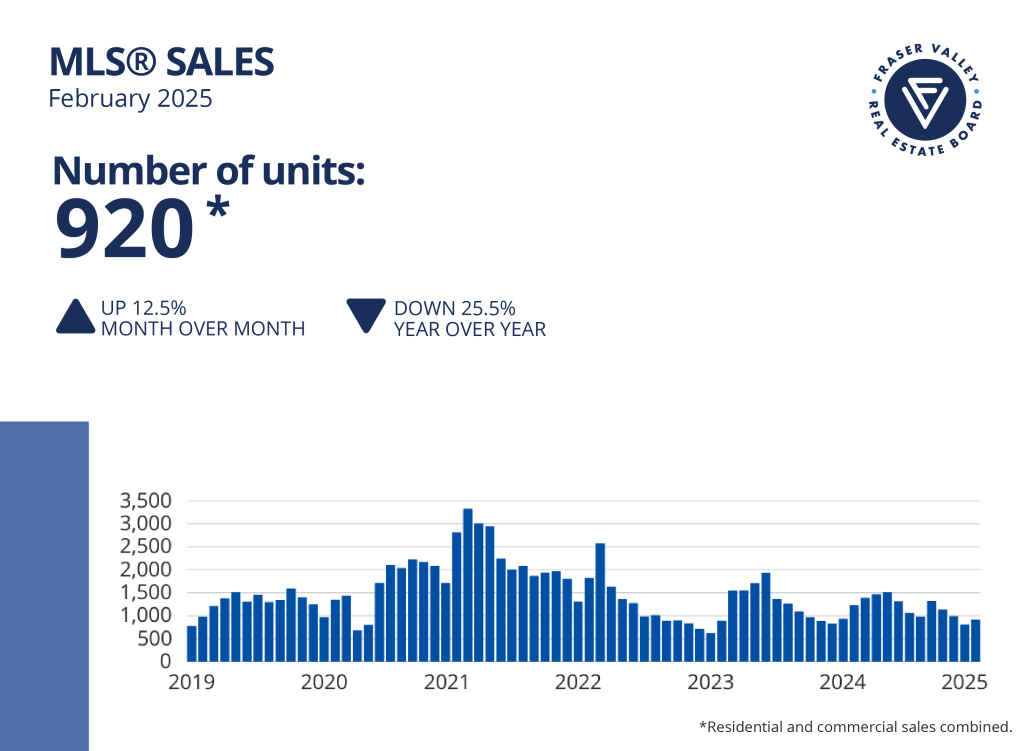
The Fraser Valley Real Estate Board recorded 920 sales in February, up 13% from January, but 26% below sales recorded in February 2024. This increase is partly seasonal, but also signals shifting buyer confidence as rates drop and inventory grows.
Despite a 9% drop in newly listed homes on the Board’s MLS®, new listings remained 14% above the 10-year seasonal average, at 3,121. Overall inventory remains high, at 8,070 active listings, 45% above February 2024 and 55% above the 10-year seasonal average.
The overall sales-to-active listings ratio continues to signal a buyer’s market in the Fraser Valley, with a ratio of 11%, unchanged from last month. The market is considered to be balanced with the ratio is between 12% and 20%.
Now for anyone that checks in regularly, what I’ll say next comes as no surprise, but for those of you that are new here, the Fraser Valley isn’t all one contiguous market, and certain areas and property types are performing better than others. Detached homes, particularly in higher-priced markets, are facing affordability pressure, while townhomes are absorbing demand from buyers priced out of single-family homes
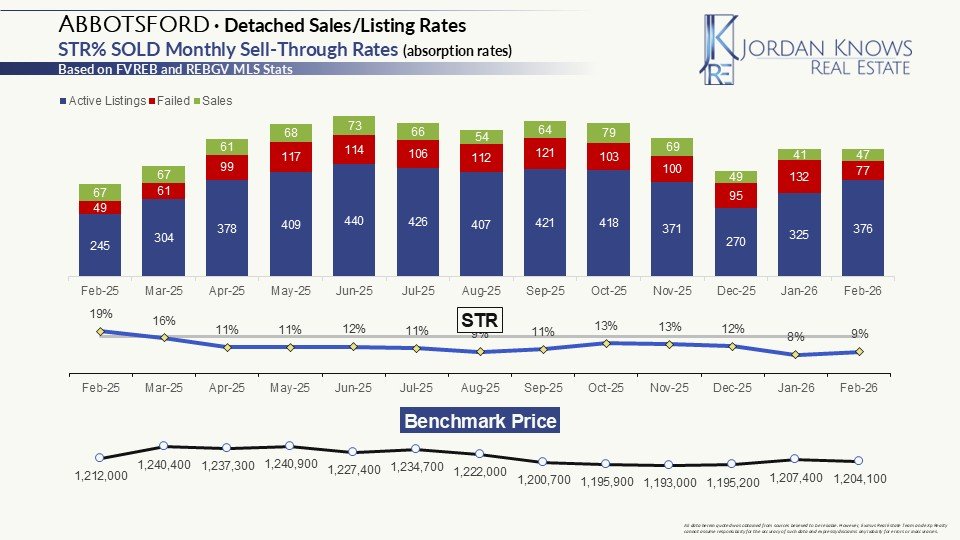
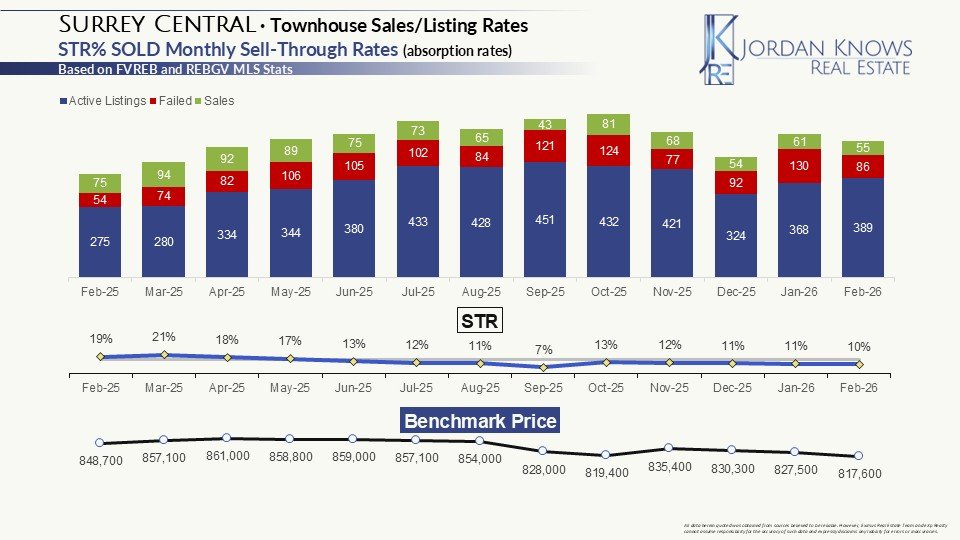
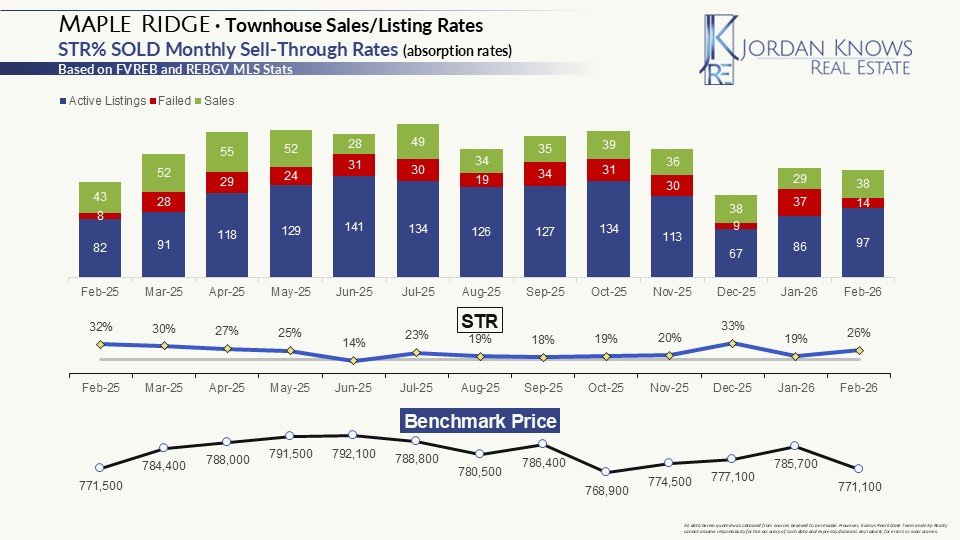
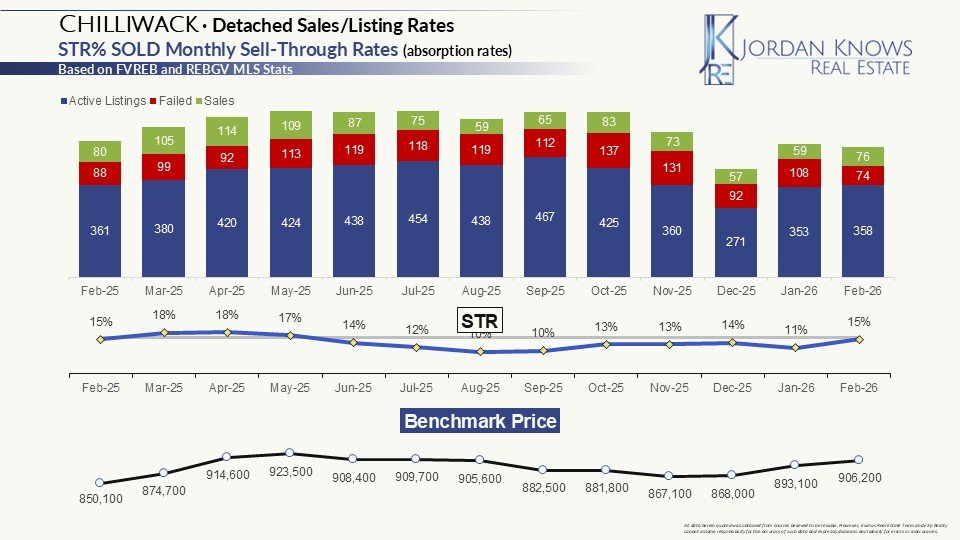
Detached markets from Abbotsford through to Surrey are deep in buyer’s markets with flat or declining pricing. While attached homes, like Maple Ridge townhomes are in a strong seller’s market, with a sell through rate of 26%. One of the most affordable detached markets in the valley, Chilliwack, has moved into a seller’s market and have seen prices increase by 4.4% over the last 3 months. Chilliwack’s shift into a seller’s market isn’t surprising, affordability is king, and buyers are looking where their dollars go further.
Understanding these unique market dynamics can help you make better decisions, whether you’re buying or selling. If you’d like to dig deeper into these stats, check out the market areas.
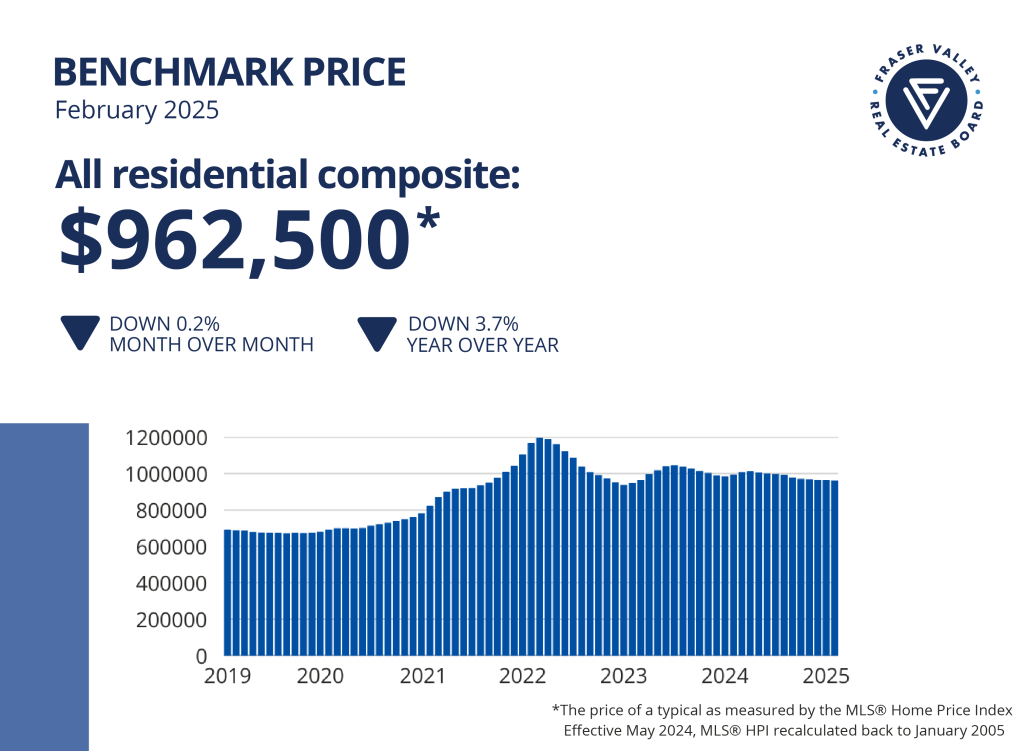
The composite Benchmark price in the Fraser Valley dipped less than a quarter of a per cent in February, down 0.2 per cent to $962,500. Homes also sold slightly faster.
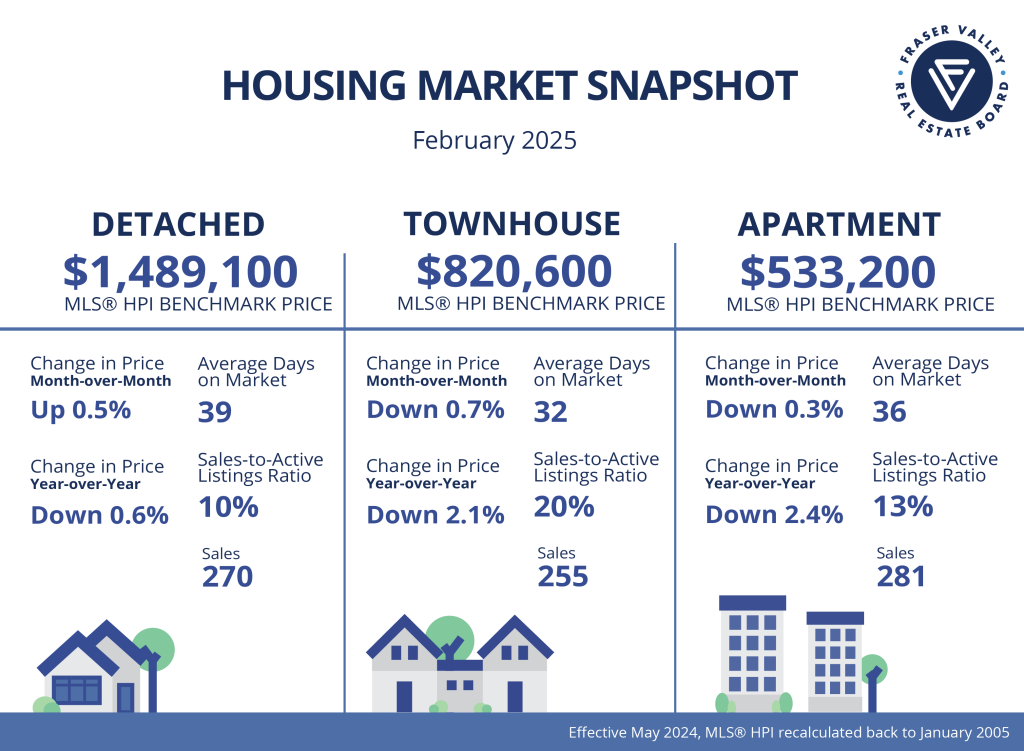
Taking a look at HPI Benchmark price activity by housing type
- Single Family Detached: increased to $1,489,100, up 0.5% compared to January 2025 and down 0.6% compared to February 2024. They took on average 39 days to sell. That’s 13 days faster than the previous month, so a healthy bump
- Townhomes: decreased to $820,600, down 0.7% compared to January 2025 and down 2.1% compared to February 2024. They took on average 32 days to sell, 6 days faster than last month
- Apartments: decreased to $533,200, down 0.3% compared to January 2025 and down 2.4% compared to February 2024. They took, on average, 36 days to sell. Also 6 days faster than the previous month
You may be wondering how prices have been relatively stable despite the record high inventory, shouldn’t prices have collapsed already? Buyers have more options than ever before, they should be able to negotiate cheaper prices. We should be seeing fire sales, what’s going on? Unfortunately this ignores some of the statistical realities that are lost when looking at how homes have been selling.
I put out a video a couple of weeks ago, looking at average vs. median days to sell, and how they tell a very different story. Avg. days to sell for all property types was faster in February than January, about 18% faster combined, but still well over a month in most cases. Compare this to the median days to sell and you see a different picture. For all property types, median days to sell was about 14-15 days. Which means, when you isolate for the properties that finally sold after months or years on the market, the ones that wildly skew average days up, like this Tsawwassen home that took 884 days to sell, you see that half the homes on the market sold in 2 weeks or less.
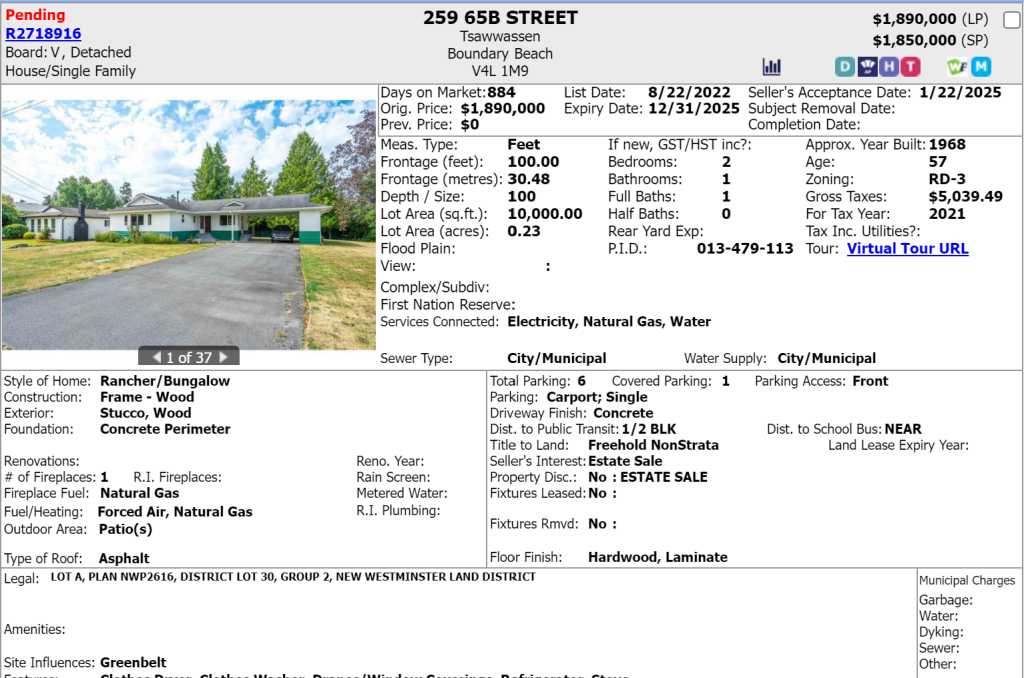
What this means is that the desirable B+ & A properties are still moving relatively quickly, and for close to or even above list price in some cases. This helps to insulate HPI from large drops, and reinforces the idea that if you have a desirable home, that’s priced right, buyers will take it off your hands quickly.
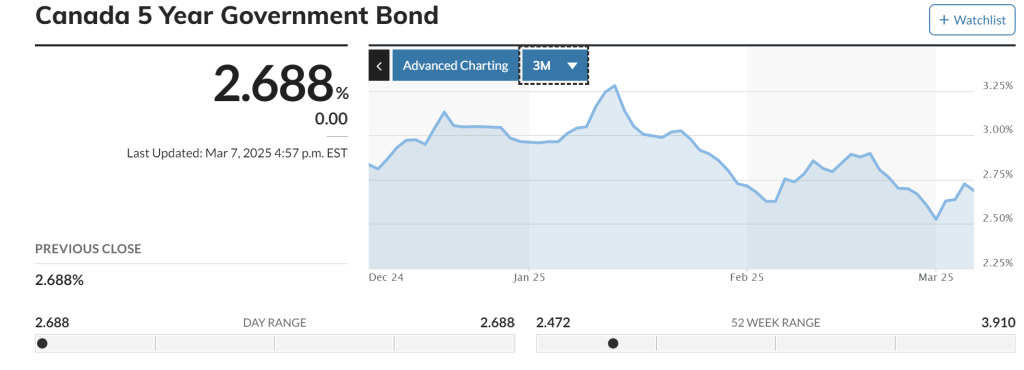
Rates have finally come down to the low 4’s, helping buyers afford much more than they could last year. Bond yields have been stable, so I don’t expect much of a drop in fixed rates, but am hoping to see another quarter point drop at the next overnight rate announcement, scheduled for March 12. If rates hold or decline further, we may hit a tipping point where sidelined buyers re-enter, accelerating demand.
The above is at least true so long as our economy carries on status quo, and no major extenuating circumstances reduce overall purchasing power. Hopefully we don’t get into a trade war or anything…
TARIFFS
So this is the biggest elephant in the room. I’ve had a lot of clients ask me what I think will happen to the market thanks to the tariffs, and I really can’t say for sure, at least until we get a better picture on what is actually being applied. So far we have tariffs, Canadian counter tariffs, and then retaliatory tariffs to the counter tariffs, and proposed retaliatory tariffs to those retaliatory tariffs. It’s a mess, but at least the powers that be get to beat their chest and play the hero. What will hurt Canadians in the short term will be the tariffs applied by our own government on goods that come from the states but aren’t easily replaced by Canadian alternatives, like energy and building products.
Kevin Lee, CEO of the Canadian Home Builder’s Association, held a press conference recently, discussing how US tariffs will slow the economy long term, but it’s our own government tariffs that will have the most immediate impact on building costs, which will ultimately lead to few starts, then less supply, and higher prices. The exact opposite of what we need in a housing crisis.
The US tariffs will have an impact if they stick around, but it will take time for that to be felt through our economy slowing down, job losses, and less tax revenue.
China also just decided to join the fray and impose their own 100% tariffs on many Canadian goods. So we’re officially in a trade war with our two largest trading partners. My only hope is that cooler heads prevail and we can come to agreements fairly soon on both fronts. Our leaders for the last decade have not left us in a position to fight this at length without serious hurt. What we may end up seeing is tarifflation, where the economy is significantly slowed and the Bank of Canada is forced to cut rates and inject cash to keep the lights on (money printer goes BRRR), while the prices of everything climb and many are out of work.
Sure, homeowners will see their asset values increase again, at least in the short term, but have fun with the cost of living going up yet again.
That’s my take, but I’d love to hear yours. How do you see this playing out? Do you think the tariffs will last long term? Will this lead to asset inflation and wage stagnation, or will we see a different outcome?
Drop a comment, send me a message, I’d love to hear your take. And if you have any questions about buying, selling, or investing in Fraser Valley real estate, let’s chat. I’m always happy to help.


