
In Canada, the dream of homeownership feels like it’s slipping further out of reach for many. Headlines scream about the disparity between income and housing prices, with average home prices soaring well beyond what the median household can afford. But before we throw in the towel and say, “I’ll never afford a home,” let’s step back and take a closer look at what the property ladder really means today, and how our expectations, entitlement, and a changing game have played into the narrative.
Average vs. Median: The Numbers Don’t Tell the Same Story
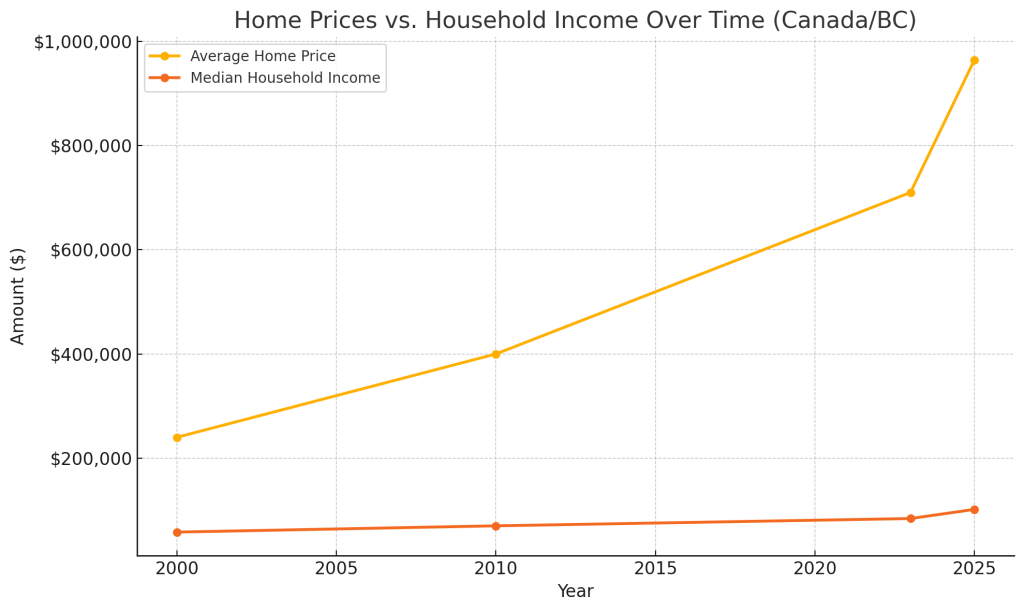
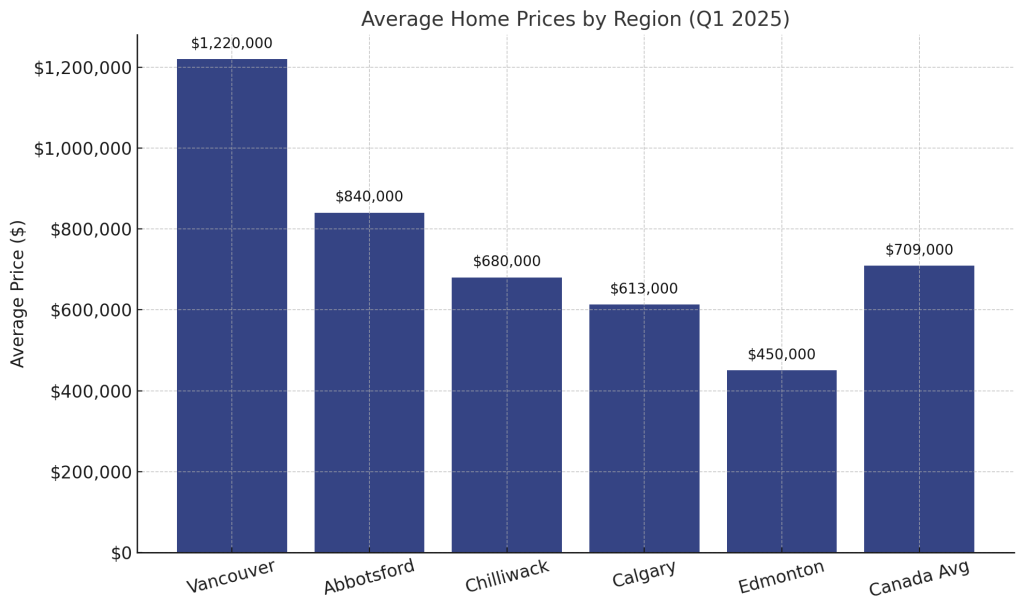
As of early 2025, the average home price in Canada is around $709,000, while the median after-tax household income hovers around $60,000 nationally. That’s an 11.8:1 ratio, nearly triple the historical norm of 4:1. In British Columbia, where home prices are among the highest in the country, the average has surpassed $964,000. Meanwhile, BC’s median household income (as of the most recent data) is approximately $101,520. This disconnect is even more pronounced in regional hotspots.
Here’s the kicker: comparing average home prices to median household income gives a distorted picture. Average prices are heavily skewed by high-end sales, particularly detached homes in areas like Vancouver. Median home prices, what most people actually pay, tend to be significantly lower and provide a more realistic benchmark for affordability. That’s why, when assessing housing attainability, it’s important to compare median income to median home price.
Detached homes, particularly in markets like Vancouver, continue to skew the average. The median price for a detached home in Vancouver is now approximately $2.12 million. But zoom out to include townhomes and condos, and a different story emerges. For example, a condo in Chilliwack averages around $350,000.
The Growing Gap Between Home Prices and Household Income
| Year | Median Household Income | Average Home Price | Median Home Price |
| 2000 | $58,000 | $240,000 | $200,000 |
| 2010 | $70,000 | $400,000 | $300,000 |
| 2023 | $84,000 | $710,000 | $420,000 |
| 2025 | $101,520 (BC) | $964,000 (BC Avg) | ~$700,000 (est.) |
Over time, housing prices have far outpaced income growth, creating a sense of hopelessness for first-time buyers. A chart showing the divergence in home prices vs. household incomes over time would illustrate just how fast this gap has grown. But again, median home prices are more relevant to what a typical buyer faces, and they show that the situation, while challenging, may not be quite as dire as average prices suggest.
Rethinking the Starter Home
Gone are the days when the starter home was a detached house with a white picket fence. Shrinkflation has hit the housing market too: the same amount of land is now divided among more people, leading to smaller slices of the same pie. Today’s starter home is more likely a two-bedroom condo or a three-bedroom townhome.
While these smaller homes can still feel expensive, many affordable options exist, especially if you look beyond major city centers. Young families are adapting, choosing townhouses in places like Surrey or Abbotsford rather than chasing single-family homes in Vancouver.
Comparing Vancouver to the Fraser Valley
| City | Detached Home Price | Condo Price | Townhome Price |
| Vancouver | $2,120,000 | $800,000+ | $1,100,000+ |
| Surrey | $1,500,000 | $600,000 | $850,000 |
| Abbotsford | $1,000,000 | $450,000 | $650,000 |
| Chilliwack | $900,000 | $350,000 | $500,000 |
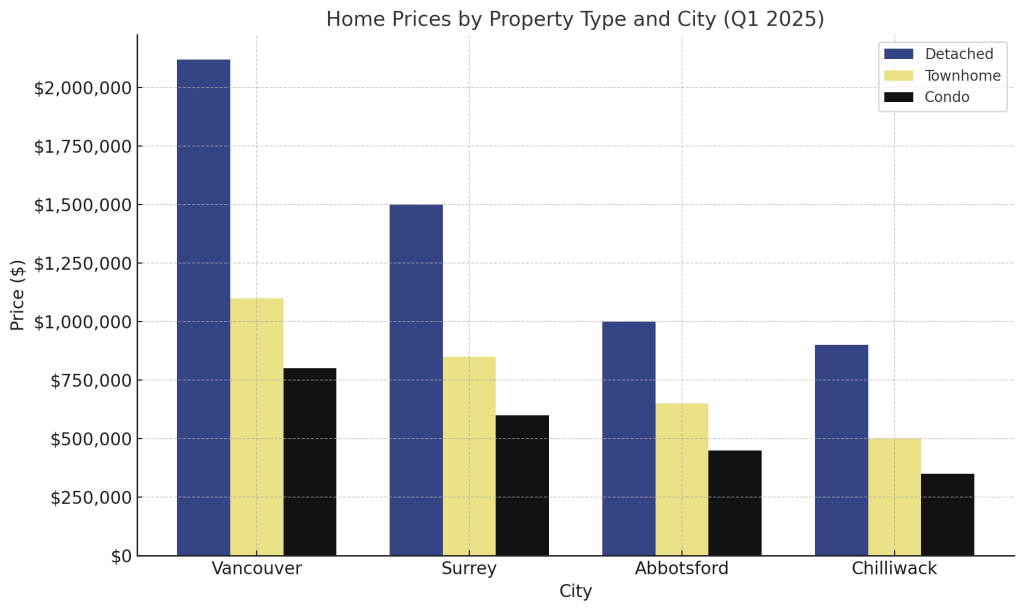
That’s not just a difference in price, it’s a difference in opportunity. You’re not paying for just the home, you’re paying for proximity to Vancouver. If you’re willing to move an hour away, the cost savings can be substantial.
Alberta vs. BC: A National Comparison
If you’re truly after affordability, Alberta stands out. The average home price in Calgary is around $613,000. In Edmonton, it’s closer to $450,000. But with those savings come trade-offs: harsher winters, different job markets, and a longer distance from the coast.
Still, it highlights a key point: buyers in BC aren’t just paying for space, they’re paying for weather, proximity to the ocean, and a certain lifestyle. Fraser Valley communities like Abbotsford and Chilliwack offer a middle ground, significantly more affordable than Vancouver, but still offering West Coast charm.
Are We Too Entitled to Move?
Here’s where we have to be honest: part of the issue isn’t just affordability, it’s entitlement. Many Canadians, especially those raised on stories of their grandparents buying homes on a single income, expect to own a home in the exact neighborhood they grew up in. And yet, we’re not willing to make the sacrifices they did.
Take my Opa, for example. He emigrated from Holland in the 1950s with his family of seven. They lived in a two-room apartment for years before they could afford their first farm, which was, at the time, in the middle of nowhere. He crossed an ocean and lived in tight quarters to build a better life. Today, many of us won’t even cross the Fraser River.
That said, it’s important to acknowledge that the game has changed. Housing is undeniably more expensive, wages haven’t kept pace, and the barriers to entry are higher. As BCREA Chief Economist Brendon Ogmundson put it, “Prices are still very high, interest rates are higher than they were for many years, and qualifying for a mortgage remains difficult.”
But here’s the thing: when the game gets harder, you have to level up. That might mean working longer, saving more, or, yes, moving to an easier zone. As Ogmundson also said, “People looking to house a new family are heading for townhouses instead.”
The Fraser Valley: Opportunity Awaits
Abbotsford and Chilliwack are no longer the “middle of nowhere” locations they might have been decades ago. These cities have thriving communities, excellent amenities, and growing job markets. With housing prices at a fraction of Vancouver’s, they represent a chance to step onto the property ladder without falling off a financial cliff.
Sure, it’s not downtown Vancouver. You won’t have the skyline views or the proximity to Stanley Park. But you’ll have something arguably more valuable: a home you can afford and a community you can grow with. And isn’t that what the property ladder is really about?
Step Up or Step Out
The property ladder isn’t gone, it’s just different. The starter home of today might not look like the detached house of yesteryear, but it’s still a start. By adjusting expectations, looking beyond city centers, and being willing to make sacrifices, homeownership is still within reach for many Canadians.
Yes, the game has changed. It’s harder now. But with the right mindset and a willingness to adapt, the dream of owning a home doesn’t have to be out of reach. So step up, or step out to where opportunity awaits.


