
October’s Delayed Push and November’s Market Slowdown
So you’ll recall last month I mentioned that despite the industry at large claiming it was rate drops driving the bump in sales we saw in October I believed it was more likely to be a delayed fall push that would have otherwise have come in September. I also predicted that the market would slow again in November as the rate drops we saw didn’t affect most buyers that were looking for fixed rate products, which hadn’t changed. That’s exactly what we saw last month.
With the “told ya so” out of the way, let’s talk stats, and then I’ll break down what I’m seeing in the wild.
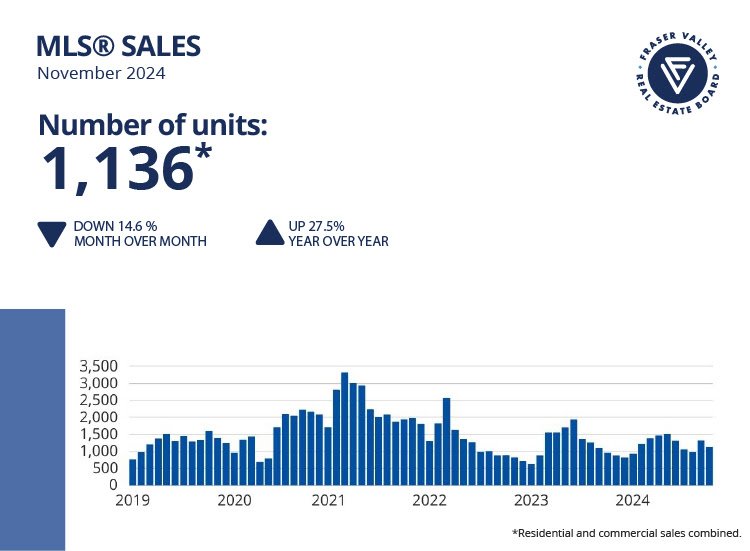
The Fraser Valley Real Estate Board recorded 1,136 sales in November, down 15% from October, but 28% above November 2023 sales.
A decline in new listings chipped away at overall inventory in November, with active listings declining 8% to 8,125. This is expected for this time of year. Everyone but the most motivated Sellers are going to start hunkering down for the winter. Buyers take note, however, there won’t be as many options, but those on the market want to sell, so keep an eye out for deals. Or you know, let me do it for you.
Overall inventory, however, remains at a 10-year seasonal high and 30% above November 2023 levels.
New listings dropped 26% in November to 2,367, but remain above the 10-year seasonal average and above levels from November 2023.
The Fraser Valley remains in a balanced market with a sales-to-active ratio of 14%, according to board stats.
The market is considered to be balanced by the board when the ratio is between 12% and 20%. Bear in mind, it’s balanced due to the bulk of detached markets being pretty deep into Buyers market territory, while attached, townhomes & condos, are fairing better, pulling the average up.
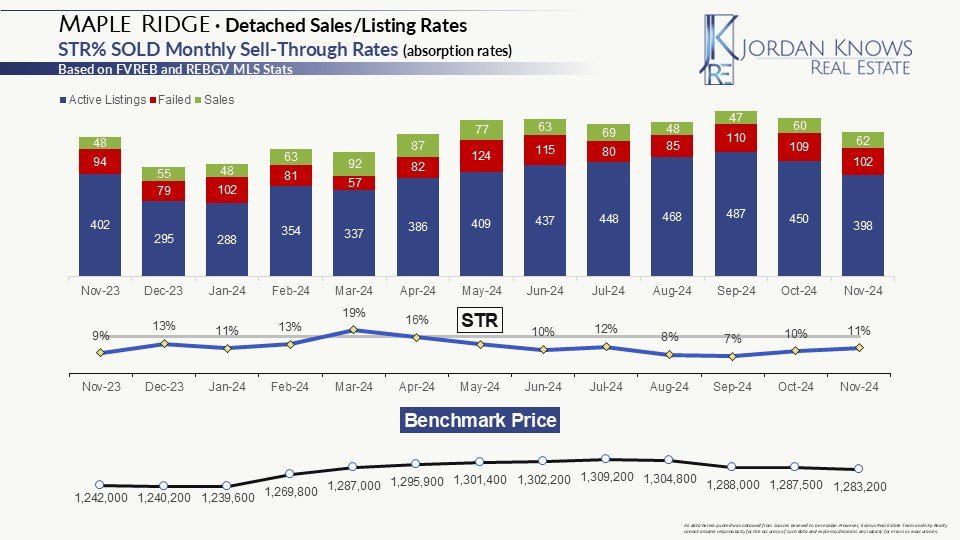
Maple Ridge detached, for instance, are seeing an 8% sell through rate.
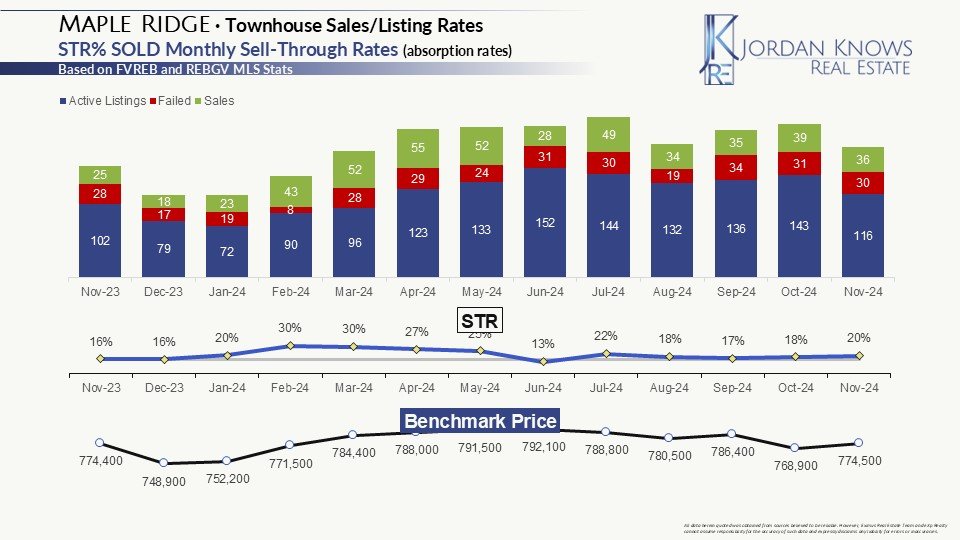
This while Maple Ridge townhomes are selling through at a brisk 20%. If you’re looking for more in depth breakdowns by city and property type, check out the market areas page.
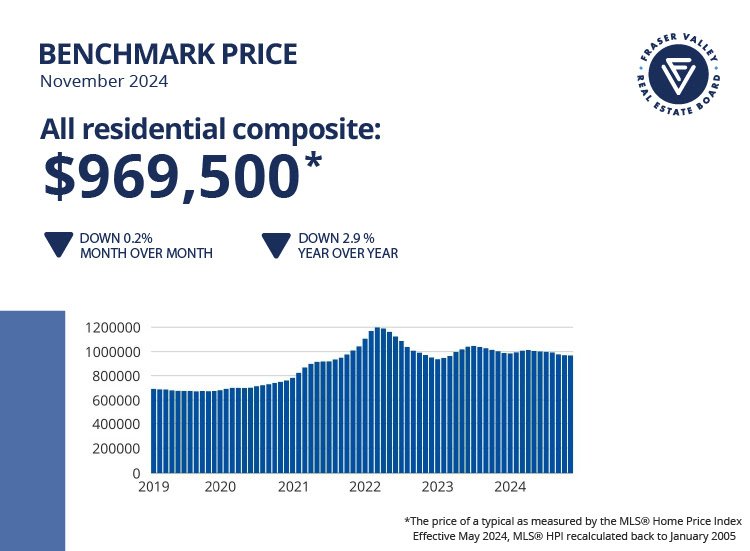
Benchmark prices in the Fraser Valley dipped for the eighth straight month in November, with the composite Benchmark price down 0.2% to $969,500.
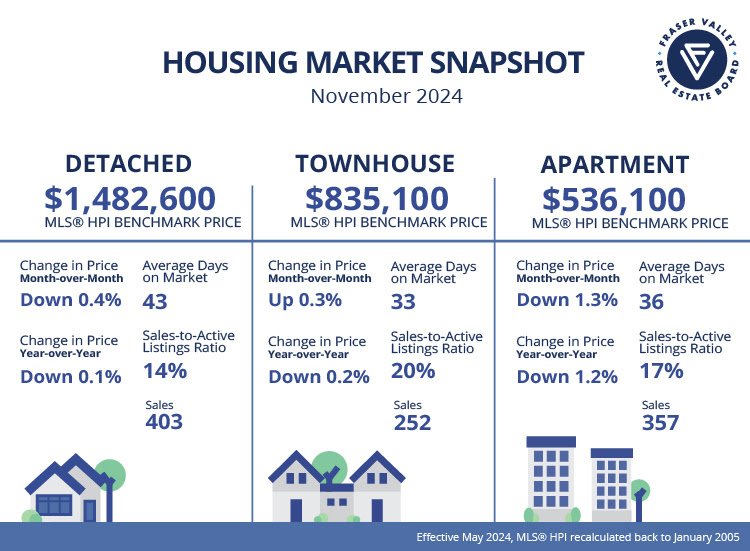
Taking A Look at HPI Activity by Property Type
- Single Family Detached: fell to $1,482,600, that’s down 0.4% compared to October 2024 and down 0.1% compared to November 2023. It took an average of 43 days to sell, 9 days slower than last month.
- Townhomes: rose to $835,100, up 3% compared to October 2024 though that’s down 0.2% compared to November 2023. They took an average of 33 days to sell, 4 days slower than last month.
- Apartments: fell to $536,100, down 1.3% compared to October 2024 and down 1.2% compared to November 2023. They took an average 36 days to sell, also 4 days slower than last month.
I was a little surprised to see condos fall so much month over month relative to detached and townhomes, and I’ll be the first to admit I misjudged that one slightly. I had thought that we were pretty close to the bottom on that product type, but it seems we have a little ways to go yet.
Realistically we’re talking about a 1% change, but it adds up in the long term.
Interest Rates: Fixed vs. Variable Trends
There’s a Bank of Canada rate announcement scheduled for December 11th, so place your bets on whether variable rates come down again.
I’m a bit split here. I’m hoping to see another 0.25% drop, but I wouldn’t be shocked to see them hold, given the positive economic data they “found” Better Dwelling last month, and given that inflation is in their target range. I love how the author of this Better Dwelling article put it, “Canada must have found some economic progress in an old winter coat.”
Don’t worry folks, we’ve got trained professionals in charge, that aren’t flying by the seat of their pants at all.
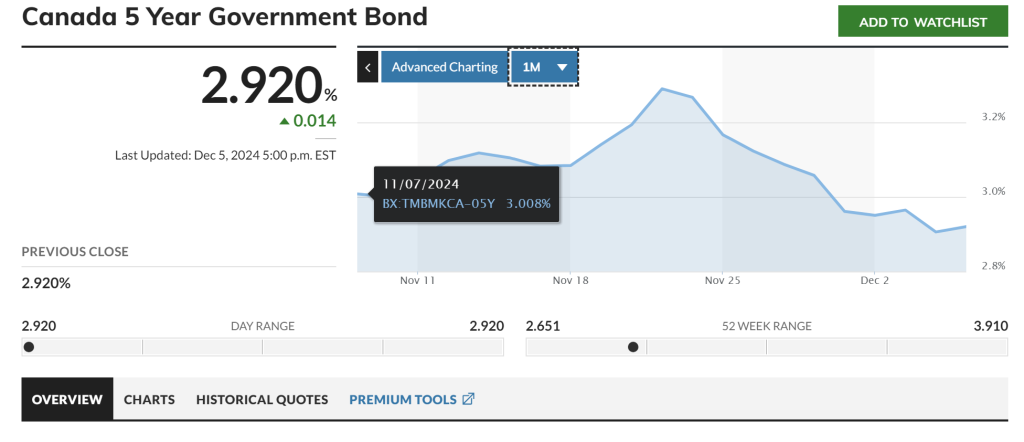
Fixed rates are currently sitting in the 4 to 4.5% range, and 5 year bond yields have dropped and leveled off a bit, currently sitting at 2.92% at time of writing/recording, after having jumped from 2.75 all the way up to 3.2% last month. They’ll need to fall another 25 basis points before we start to see rates fall to the mid 3’s. I’m still hopeful we get there by early 2025.
I had a conversation with a mortgage broker colleague this morning, and he found it likely as well. We were discussing how the potential rate drop would improve one of our mutual clients purchasing power. He made the comment that her buying power increases in line with every other buyer, but I countered that there is a lag in market response on this, and a proactive buyer can capitalize on falling rates if they’re quicker to the punch than everyone else.
Basically if we can get all of her ducks in a row we can secure something sooner while the market is still slow, and benefit from the potentially lower rates at close, beating the rush.
I’m still seeing strong activity on well priced listings, and homes that are considered “deals” are selling as quickly as ever. We just had a successful sale of a detached listing of mine. We sold in 5 days for over 99% of list price. The home had some challenges as far as pending work required, so the Seller decided to price the home slightly under the market value of recent sales. They had the choice of spending over $25k to improve the home to the condition required to sell in line with recently sold comparable homes, or to price it as a deal and let the buyer do the fix. They ended up about $10k further ahead by selling the dream.
CMHC’s New Rules: 30-Year Amortization for First-Time Buyers
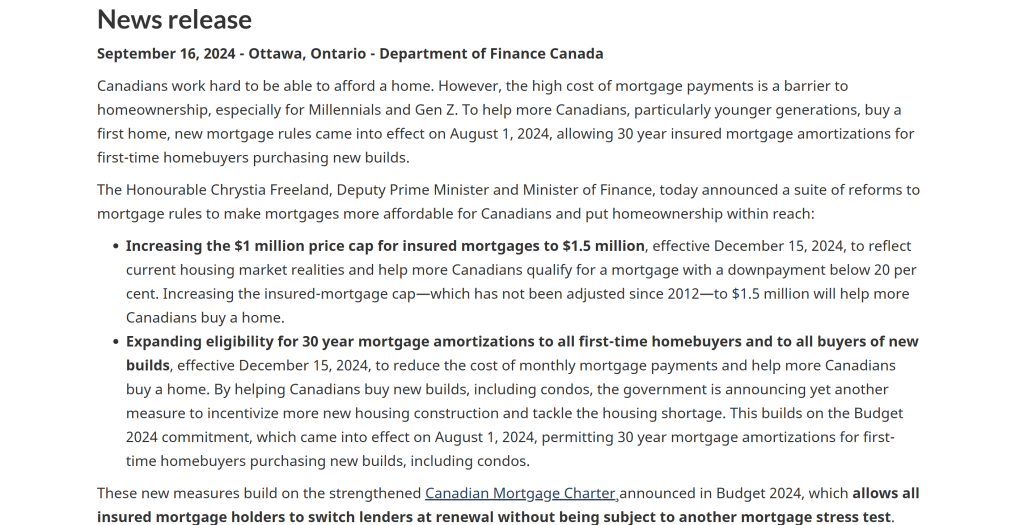
In other news, CMHC Changes the new CMHC mortgage rules come into effect this month, on the 15th. Of the myriad of changes, one of the biggest is a change increasing first time home buyers to amortize at 30 years rather than the previous limit of 25 years. Essentially letting them purchase more expensive homes by drawing the debt out over a longer period of time, thus reducing their monthly payments and increasing the total interest they pay over the life of the loan.
I’ve made my feelings on this pretty clear, basically I feel that this isn’t addressing the underlying issues that lead us to the affordability crisis in the first place, supply vs demand, while allowing one of the most vulnerable types of home buyers to further indebt themselves. Call me jaded, but I see this as purely for optics.
But that’s just my opinion, I’d love to hear yours. Were you surprised to see condo prices fall that much in November? Do you think allowing first time buyers to amortize over 30 years is in their best interest? Let me know.
And as always, if you have any questions all things Fraser Valley Real Estate, whether that’s buying, selling, or investing, give me a call!


