
Newly listed homes jumped 167% from December to January, with 3,432 listed on the Fraser Valley Real Estate Board’s Multiple Listing Service. At 7,251 active listings, inventory is at a 10-year seasonal high, 54% above the 10-year average.
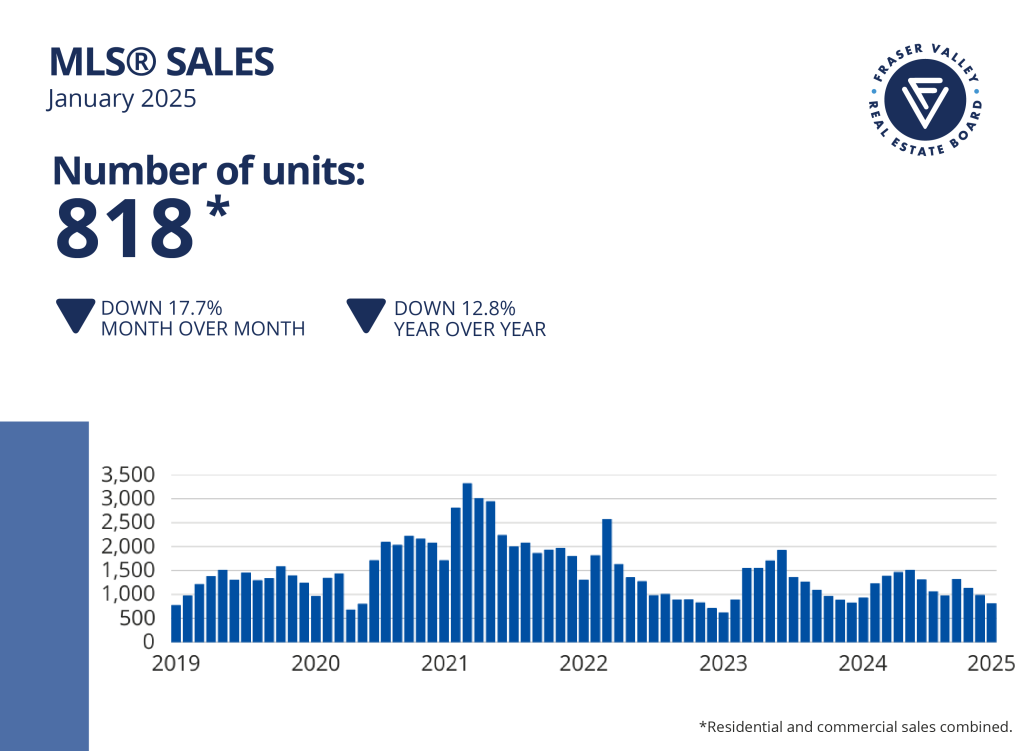
While sales remained slow in January, with 818 properties sold (down 18% from December), the combination of stable prices and abundant selection presents potential opportunities for buyers to get back into the market.
The sales-to-active listings ratio appears to bear this out. At 11%, the overall ratio is signaling a buyer’s market, with detached homes firmly in buyer’s market territory. The market is considered to be balanced by the board when the ratio is between 12-20%. As always, every market is different, and some are moving much faster than others.
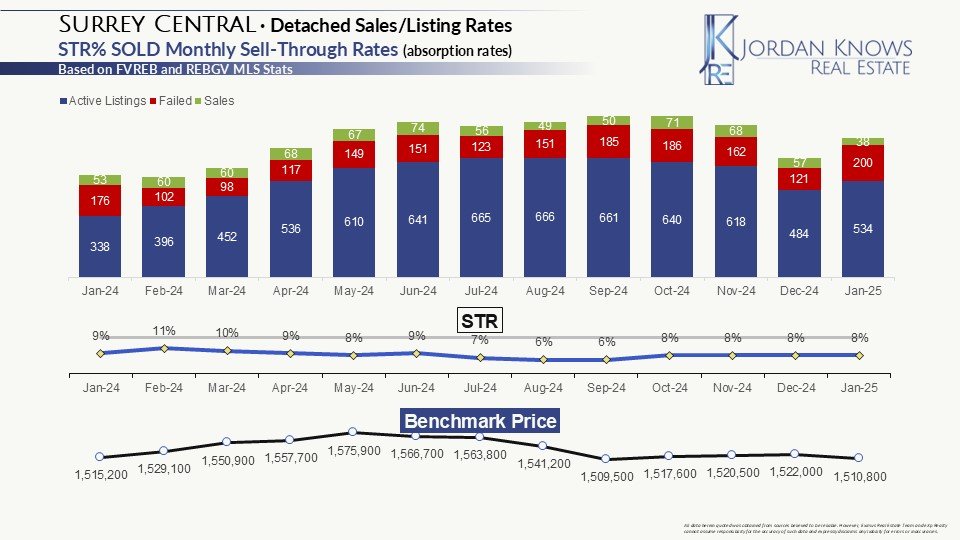
Surrey detached are deep in buyer’s market territory with a sell through rate of only 8%, while Maple Ridge townhomes are moving far faster.
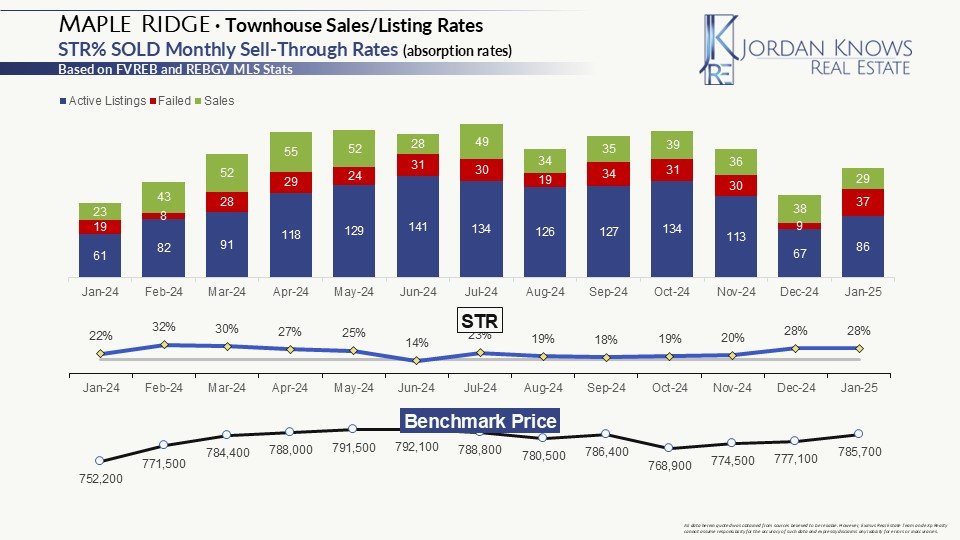
They’re in a strong seller’s market with a sell through rate of 29% and prices climbing 2.2% over the last 4 months, while most every other market has had flat or declining prices. If you’re planning to buy or sell, it’s important to evaluate the market you’re in individually, in order to make the most informed decisions. You can dig deeper into these numbers, broken out my city and property type on the market areas page.
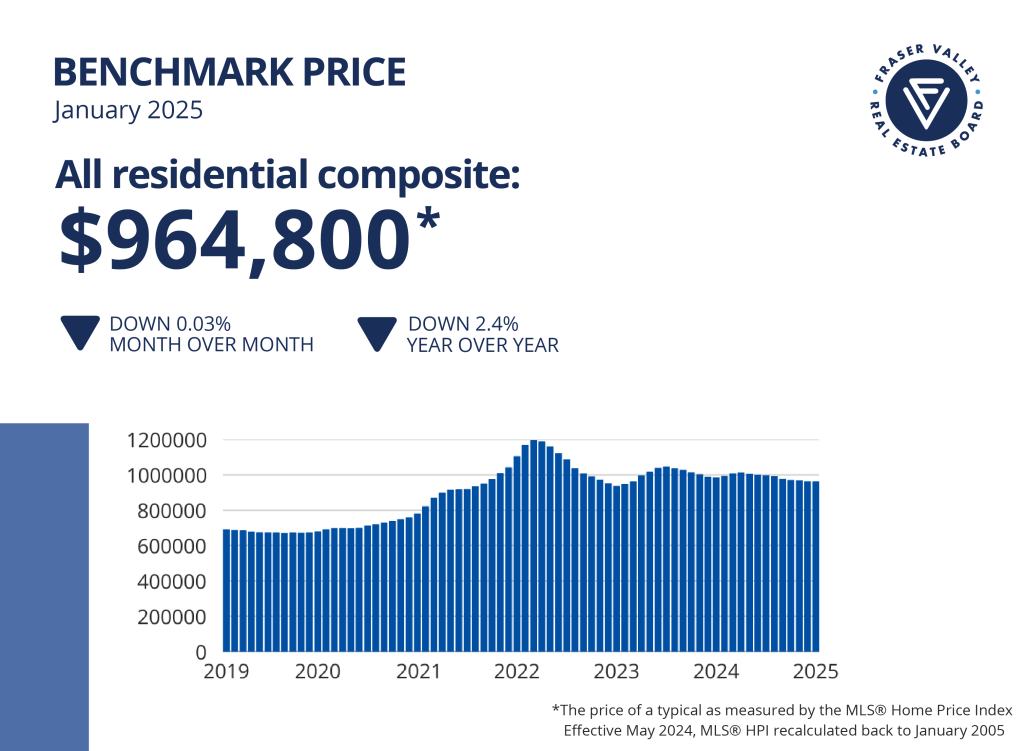
Benchmark prices in the Fraser Valley held relatively steady in January, with the composite Benchmark price down 0.03% to $964,800.
Taking A Look at HPI Benchmark Price Activity by Housing Type:
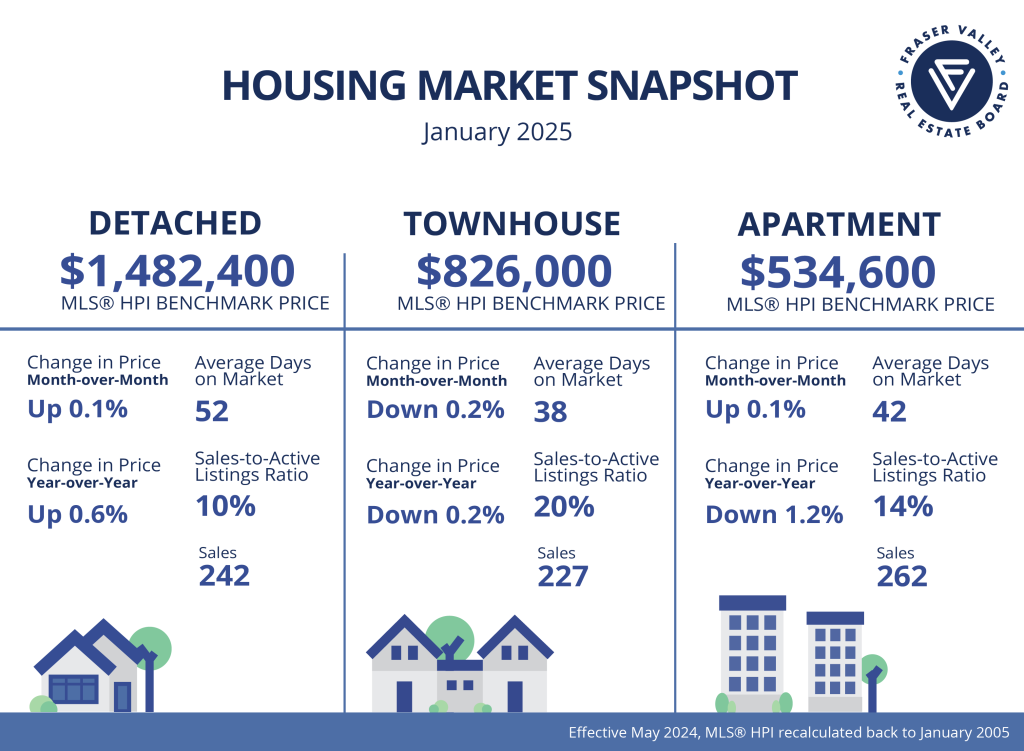
- Single Family Detached: rose to $1,482,400, up 0.1% compared to December 2024 and up 0.6% compared to January 2024. Detached were 9 days slower to sell in January vs December, with an average of 52 days.
- Townhomes: fell to $826,000, down 0.2% compared to December 2024 and down 0.2% compared to January 2024. They were 2 days slower to sell than December, with an average of 38 days.
- Apartments: rose to $534,600, up 0.1% compared to December 2024 and down 1.2% compared to January 2024. They were 4 days slower to sell in January than December, with an average of 42 days.
As expected, we saw another 0.25% drop in the Bank of Canada’s policy interest rate, bringing it down to 3%. This is the 6th decrease in a row.
Fixed and variable rates are now neck and neck, sitting at around 4 – 4.5%. It will be interesting to see what products buyers and renewing mortgage holders choose to take going forward.
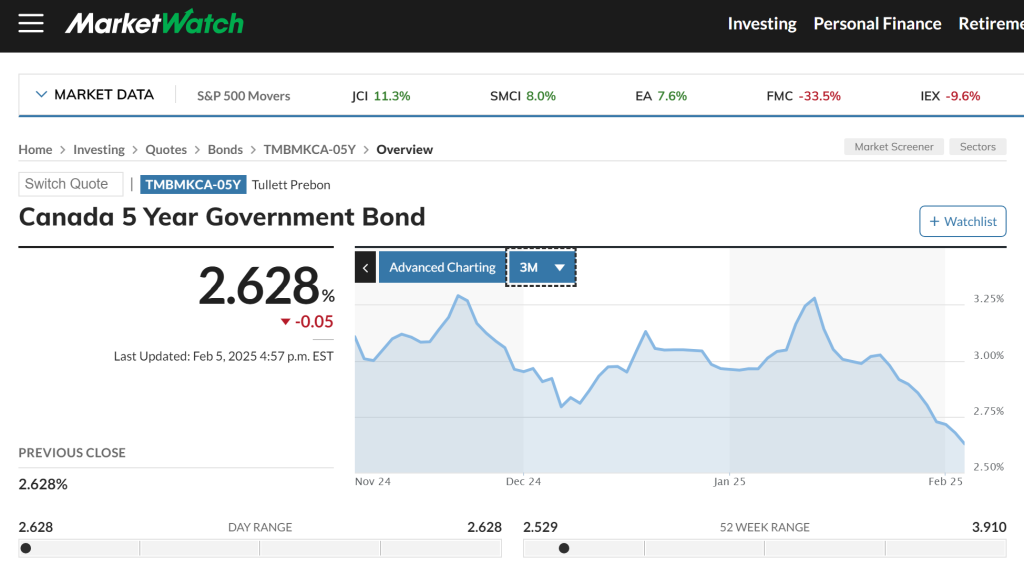
5 year bond yields are currently sitting at about 2.6%, having fallen from a high of 3.28% less than 30 days ago, as investors seek safer bets in the light of proposed US tariffs; this will likely lead to downward pressure on fixed rates.
I could see this same economic uncertainty causing the Bank of Canada to continue to drop its overnight rate, thereby reducing variable products. All in all, this is good news for beleaguered Canadian borrowers and those looking to enter the market; so long as we ignore the economic meteor hurtling toward us in the form of tariffs, global uncertainty, and whatever fresh crisis the market has in store. But hey, at least the mortgage rates are coming down.
It seems the increase in market activity we saw in January was largely due to rollover demand from the Christmas season. I had to deal with a few competing bids early on in January, but that quickly fell off. We’re back in that same holding pattern market movement, where everyone is waiting to see what happens. Failed listings increased significantly in nearly all market areas and property types, as Sellers reset for the new year. A portion of the wave of new listings will be sellers taking another kick at the can, after failing to sell last year.
In general, reducing rates would be a strong buying signal, as more purchasing power usually leads to higher prices as buyers can stretch that budget a little further. We’ll have to wait and see if that plays out, however, as buyers are still feeling the squeeze. While rates are trending downward, the rising cost of living and incoming tariffs are eating into affordability, making it harder for many to take advantage of the increased borrowing power.
At the same time, inventory levels have hit a 10-year high, which would typically suggest a more balanced or even buyer-favored market. But not all listings are created equal, well-priced homes are still moving quickly. The reported average days on market is just that, an average. Some homes are selling much faster, while others that weren’t priced correctly from the start are dragging that number higher.
Bottom line: pricing matters more than ever, and if you’re buying, it still pays to be ready to move when the right deal pops up.
CRA Tax Grab
In other news, the CRA graciously decided to delay the capital gains tax increase, and have deferred that to January 1st, 2026. I guess we’re all just going to ignore the fact that the legislation effectively died when parliament was prorogued last month, meaning the tax increase received neither parliamentary approval nor royal assent, and the CRA implementing such a change would be legally unfounded and beyond their mandate.
But that’s just my opinion, and I’d love to hear yours. Did the CRA have the legal authority to increase taxes? Will higher capital gains taxes drive investment out of Canada? Do you think tariff threats will lead to lower rates, spurring on sales, or will economic uncertainty keep buyers on the sidelines?
Send me a message, I’d love to hear your take. And if you have any questions about buying, selling, or investing in Fraser Valley real estate, let’s chat. I’m always happy to help.


