
When British Columbia’s Property Transfer Tax (PTT) was introduced in 1987 by Premier Bill Vander Zalm, it was meant as a solution. A progressive tax to curb real estate speculation and cool the overheated housing market, it was framed as a way to make higher-end property owners pay their fair share.
The Social Credit Party, the brainchild of fiscal conservatives, pushed this tax forward as a necessary evil to stabilize the market and fund the province’s programs.
Then-Social Credit finance minister Mel Couvelier told the legislature: “It will help to diversify the government’s sources of revenue without placing a disproportionate burden on taxpayers who are not in a position to pay.”
Vander Zalm’s Social Credit Party, once a dominant political force, eventually saw its members scatter—many joining the BC Liberal Party after Social Credit’s decline in the 1990s. As political fortunes faded, many asked whether this new tax contributed to the party’s eventual collapse. Real estate professionals and middle-class homebuyers alike saw this new tax as yet another burden, one that, despite initial assurances, impacted more and more people as property values ballooned.
It has survived every change of government since then.
Even though subsequent NDP premiers — Mike Harcourt, Glen Clark and Dan Miller — were fiercely against its introduction, they failed to scrap it when they took power. Other opponents continue to vent that it discourages everything from worker mobility to necessary moves for family reasons and home ownership itself; yet the tax persists.
Taxes That Don’t Go Away, They Just Keep Growing
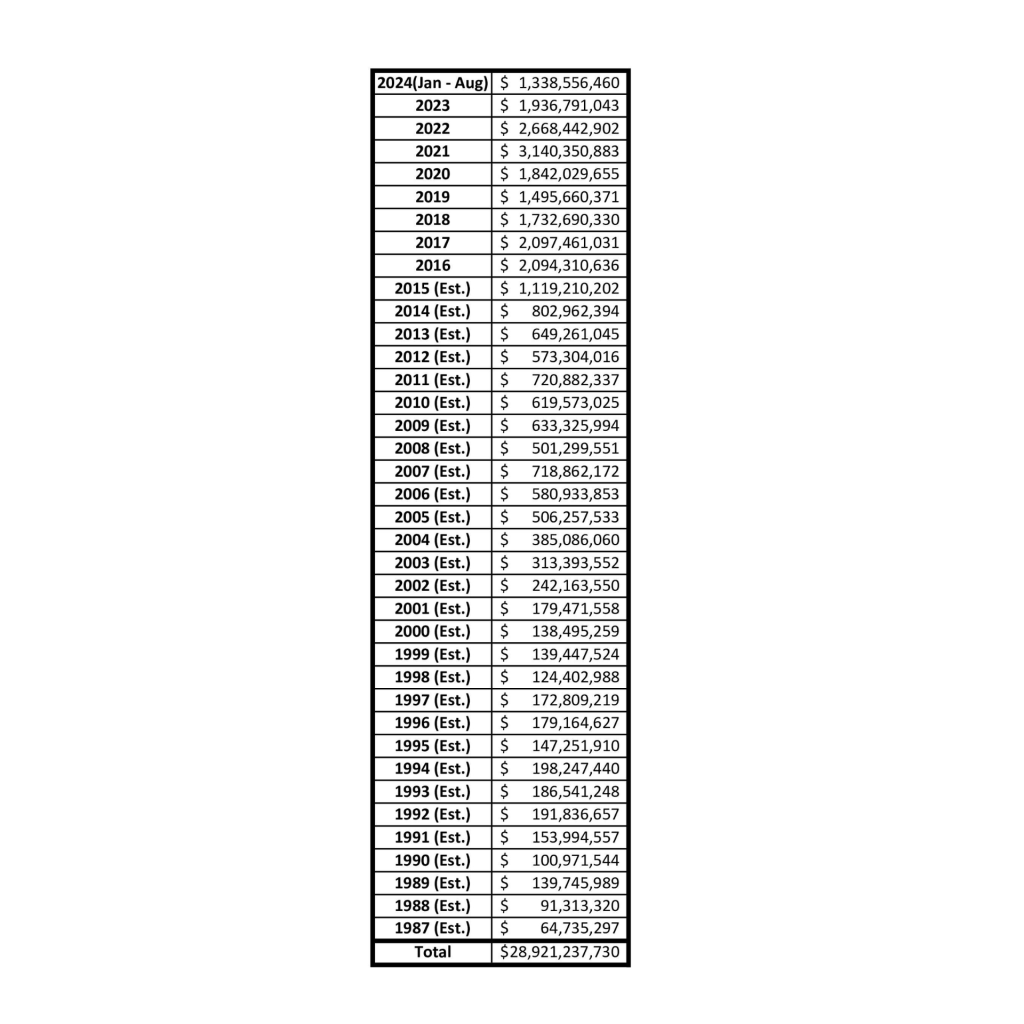
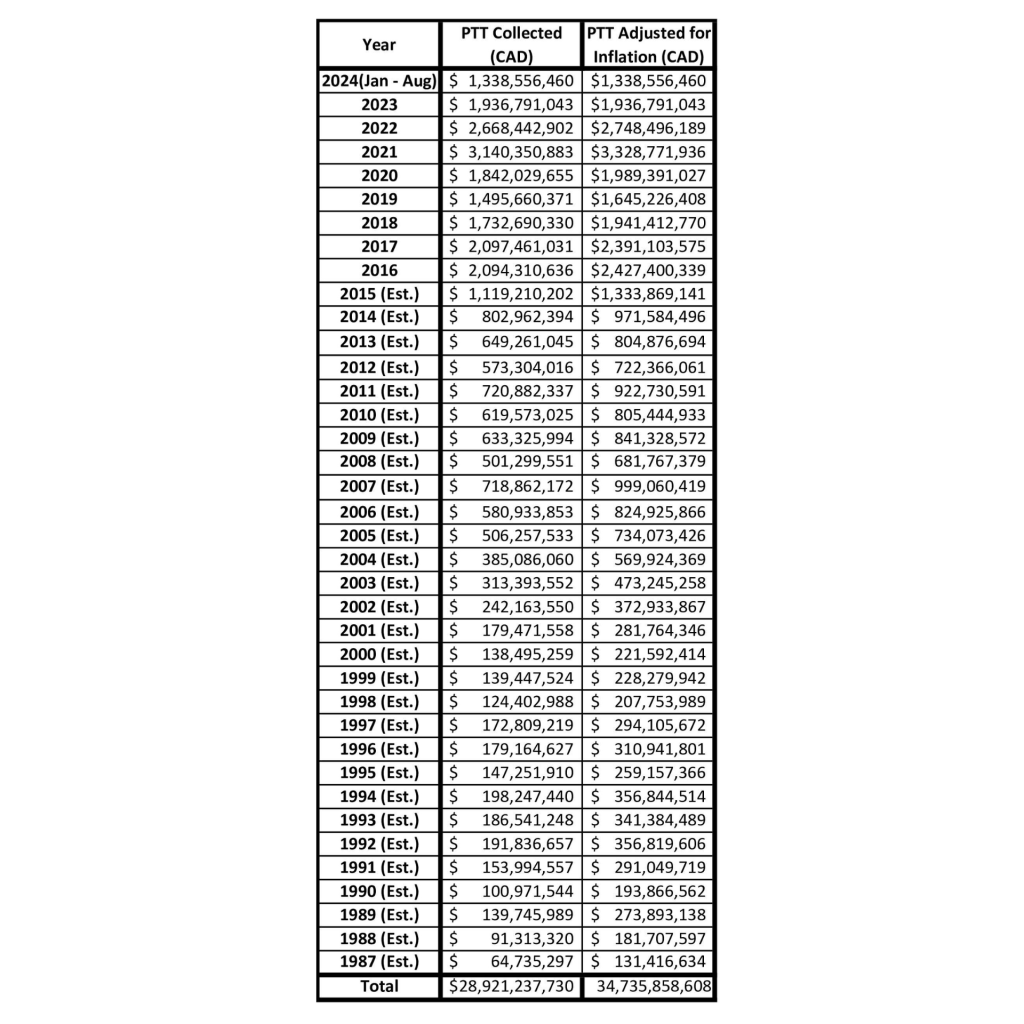
Let’s talk about the numbers. Since 2016, the PTT has generated more than $18 billion for the government. The amounts collected have skyrocketed in recent years, with higher tax tiers added in 2016 for properties over $2 million.
Here’s the annual income generated from the PTT since its inception:
Cumulative Total: $28.9 Billion
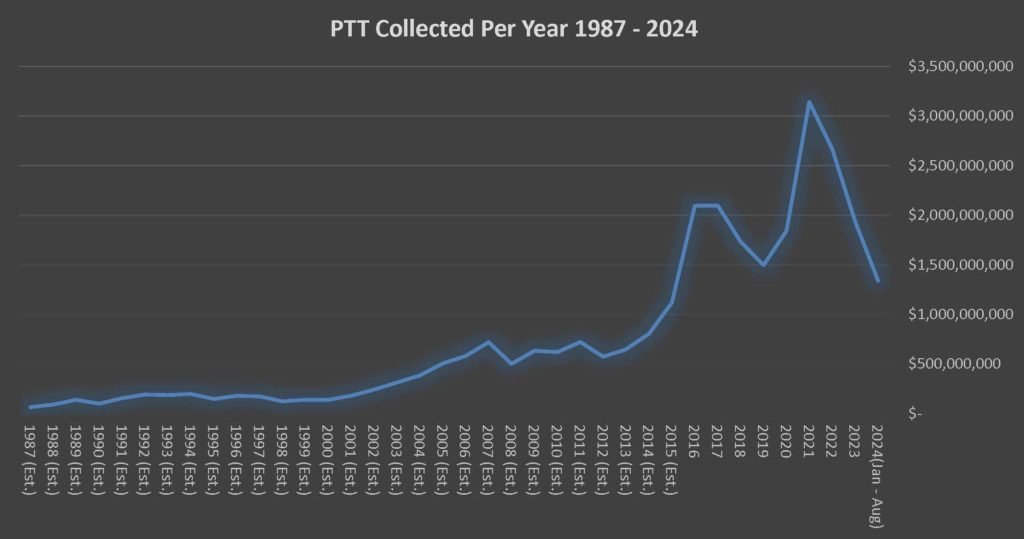
Now, when you look at that cumulative total, it’s hard to see the tangible benefits. After all, we still pay some of the highest prices for services in the country. Our roads, schools, and hospitals are chronically underfunded, overcrowded, and major infrastructure projects are delayed and over budget. Has this staggering amount truly improved life for British Columbians?
The PTT’s Evolution – A “Luxury Tax” That Was Never Just for the Wealthy
The PTT was initially framed as a way to target speculators—those buying and flipping homes for a quick profit. When it was introduced in 1987, the tax applied to all real estate transactions, with a rate of 1% on the first $200,000 of a property’s value and 2% on the remainder. While the $200,000 threshold was seen as targeting higher-end properties at the time, in 1987 the average home price in the province was under $65,000, every non-first-time homebuyer was subject to paying it. In reality, the tax impacted a wide range of buyers from the very beginning, even those purchasing modest homes.
First-time homebuyers (FTHBs) might have escaped paying the tax back then due to property values being lower and exemptions available for them, but they made up only a portion of purchasers. The PTT applied to nearly everyone else, even those buying their first step-up home or downsizing. So while it was labeled a “luxury tax,” it was actually applied across the board—just at a lower impact because property prices hadn’t reached today’s levels.
However, as property values in BC have skyrocketed, the burden of this tax has grown immensely. That once modest $200,000 threshold has remained frozen in time, even as the average home price in the province has surged. Today, the PTT applies to nearly 100% of real estate transactions—from modest starter homes to multi-million-dollar properties.
While originally seen as a tax aimed at curbing speculation and affecting high-end homes, it now impacts almost every British Columbian buying or selling a home, whether they’re first-time buyers or long-time residents.
And here we are, over three decades later, with the tax still in place, siphoning billions into the province’s general revenue fund. Yes, that’s right—despite being presented as a tax with noble intentions, it feeds into the black hole that is general revenue, with no direct accountability for what it funds. Healthcare? Education? Infrastructure? Take your pick. The truth is, we have no idea how much of that $28.9 billion in collected PTT has improved any of these areas. Adjusted for inflation, that total climbs to $34.7 Billion.
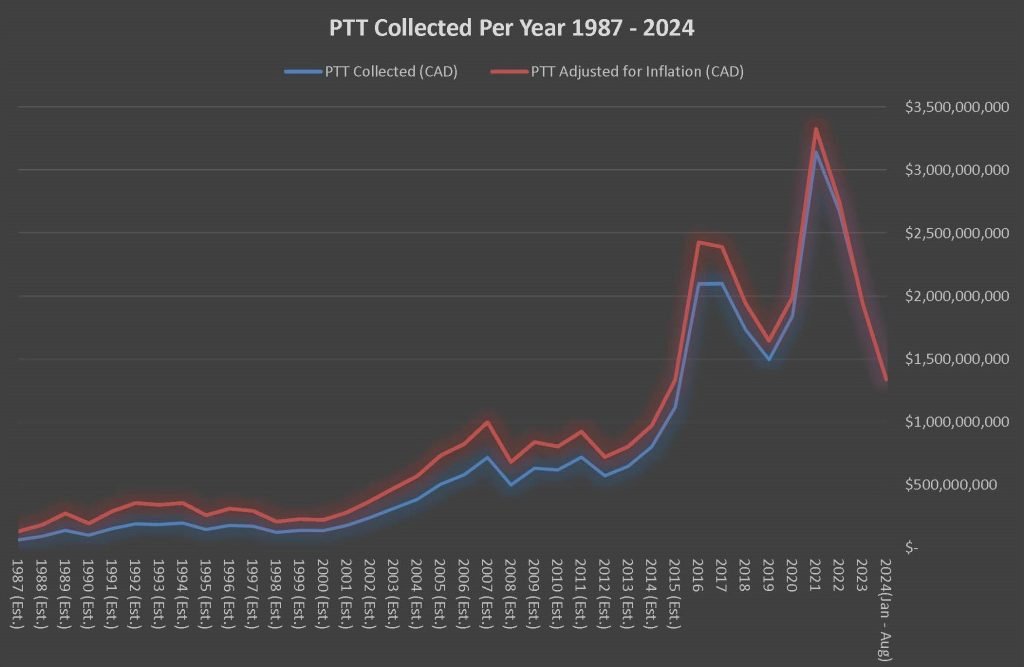
And that’s the catch, isn’t it? Taxes like the PTT never seem to go away. Once introduced, they become an everlasting revenue stream for governments—irrespective of political winds. The message to the taxpayer? Work harder. Pay more. But don’t expect to see tangible benefits.
The Sacred Cash Cow
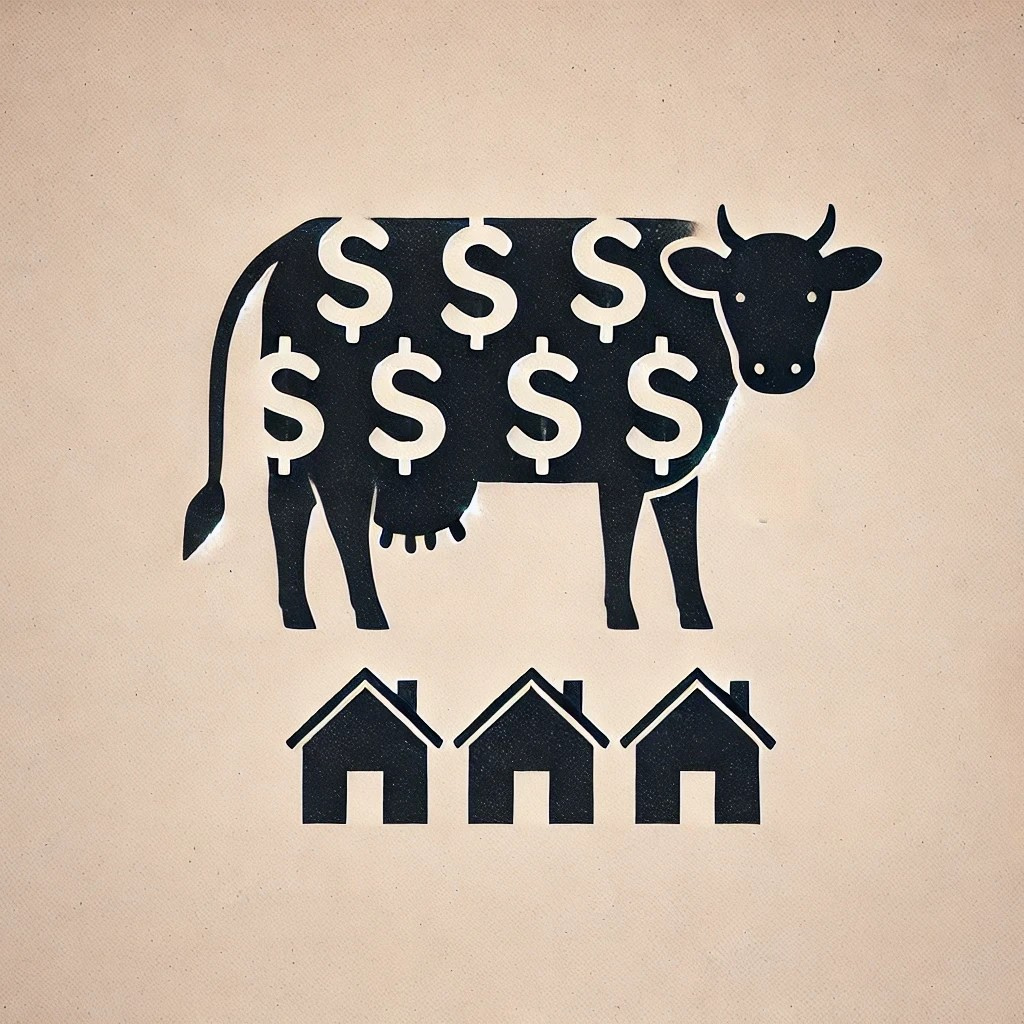
When it comes to the PTT, every property in British Columbia is like a never-ending piggybank for the government. Whether it’s a detached home, a modest townhome, or a condo, each time a property is bought or sold, the PTT meter resets, and the cash registers ring.
For example, one small home in Richmond, bought and sold five times over the years, has generated over $78,000 in PTT, but when you adjust for inflation, that number climbs even higher, surpassing $85,000 in today’s terms. Another townhome, nearly 50 years old and traded multiple times, has brought in over $61,000 in PTT, which adjusts to almost $70,000 after inflation.
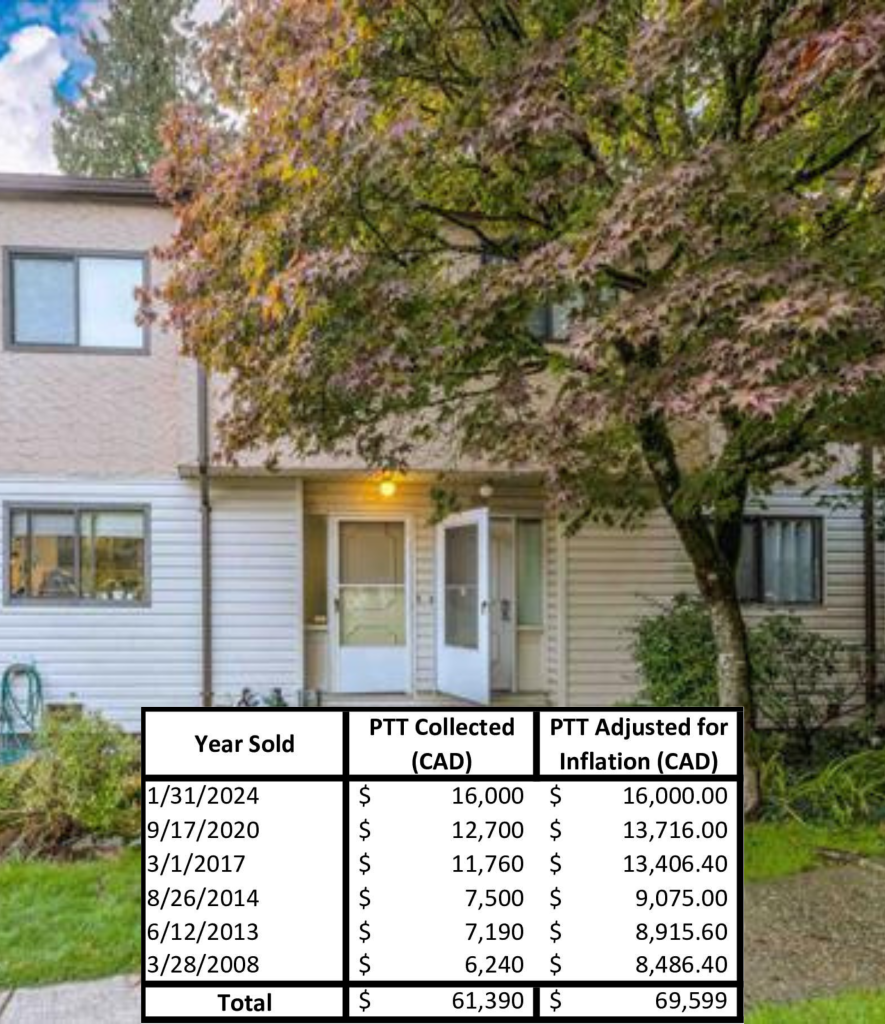
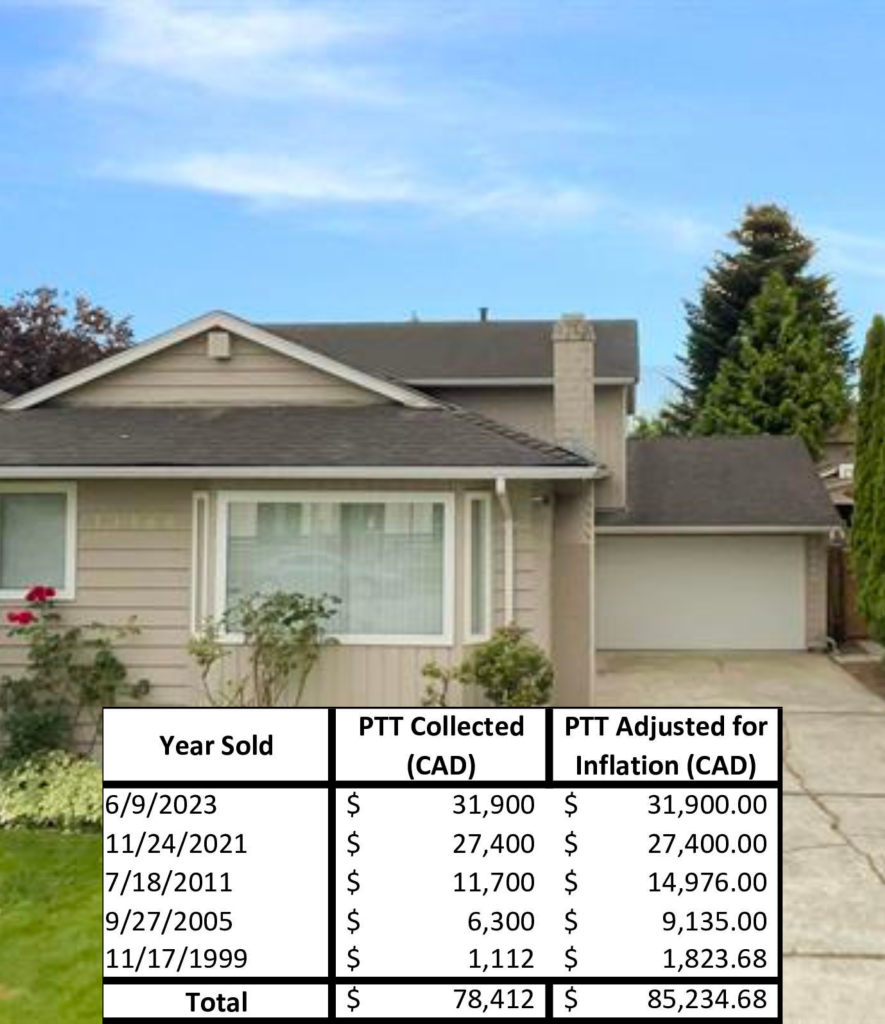
Families typically move every 5-7 years, with attached properties like condos and townhomes often seeing even higher turnover rates. Despite their lower price points and smaller PTT amounts, the frequent sales make them just as valuable a “cash cow” for the province as more expensive detached homes.
Every sale is another opportunity for the government to cash in—cha-ching, cha-ching, cha-ching—over and over again. These properties are taxed repeatedly, sometimes over decades, generating tens, or even hundreds, of thousands of dollars in revenue without any significant changes to the home itself. It’s a never-ending cycle of taxation on what are often just routine family moves.
The Burden on Buyers – How Much More Could You Afford?

One of the most frustrating aspects of the PTT is that it must be paid upfront in cash—and here’s the kicker: this money has already been taxed through income tax. You earn your money, pay income tax on it, and then when you buy a home, the government takes yet another chunk through the PTT. Effectively, it’s a double tax.
To make matters worse, the PTT cannot be wrapped into your mortgage. This means buyers need to have the entire tax amount available in cash at closing. It’s not something that can be amortized over 25 years like the rest of your home purchase.
Take a $750,000 home as an example. You’d pay $13,000 in PTT, out of pocket, at closing. That’s $13,000 in post-tax dollars you’re handing over to the government—money that could’ve gone toward your down payment.
What if that money could be added to the down payment instead? It could give you $260,000 more in purchasing power due to mortgage leverage. Imagine the home you could buy with that extra money—or better yet, imagine the boost to the local economy if buyers weren’t required to fork over these thousands in tax-free cash. Freed from this burden, buyers would be able to spend their money as they see fit—whether it’s investing in local businesses, home improvements, or simply saving for the future.
The Black Hole of General Revenue

Where does all this money go? Into the bottomless pit that is general revenue. The PTT has been contributing billions over the decades, but do you see the results?
Are our schools better funded? Classrooms are overcrowded and portables are commonplace. Is our healthcare system functioning smoothly? Emergency rooms have 12+ hour wait times, if they’re open at all. People are dying on waiting lists for procedures, and tens of thousands don’t have access to a family doctor.
In theory, the PTT is supposed to help the province manage its finances and improve services. In reality, the billions it has generated have vanished into the abyss.
Did the Tax Lower Prices? Are You Better Off?
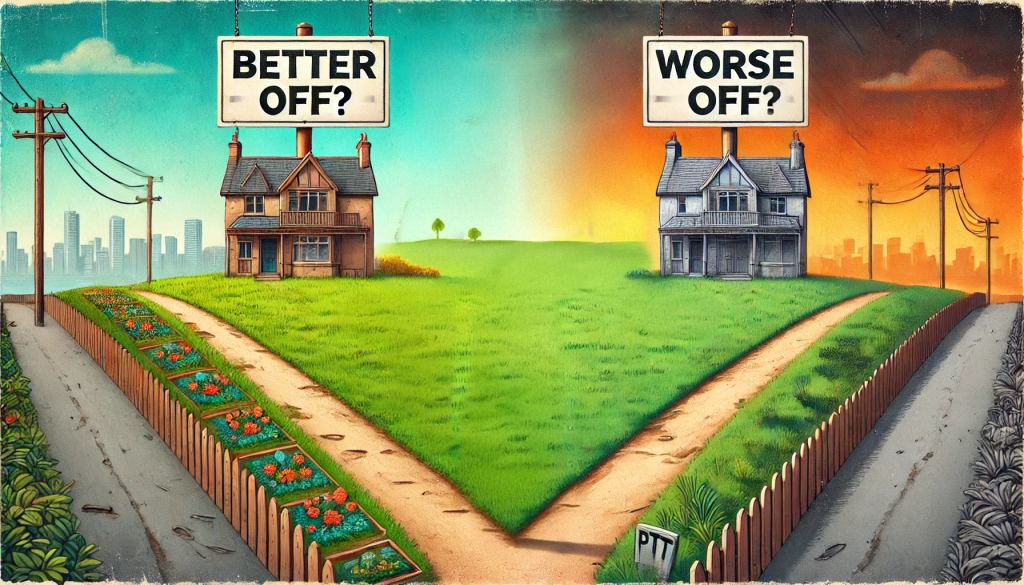
The logic behind the tax was that it would cool down the housing market and make things more affordable. Has it? Prices are higher than ever, and housing affordability is out of reach for many. If anything, the tax only exacerbates the problem, making the upfront cost of purchasing a home that much more daunting for first-time buyers. It’s a tax that doesn’t do what it was intended to do and hits everyone in the process.
And as political winds shift from spendy, progressive governments to conservative ones, the taxes don’t get rolled back. They don’t shrink. They don’t go away. We pay more for everything, and it’s not getting any better.
Work harder, little taxpayer. It’s for your own good, isn’t it?


