
Things have picked up slightly here in the Fraser Valley, but I’m still hesitant to call this the end of the downward trend we’ve been seeing for the last year and a half. First let’s talk data, and then I’ll share what I’m seeing out in the wild.
Home sales in the Fraser Valley increased for the first time in five months following a sizable interest rate cut by the Bank of Canada in October.
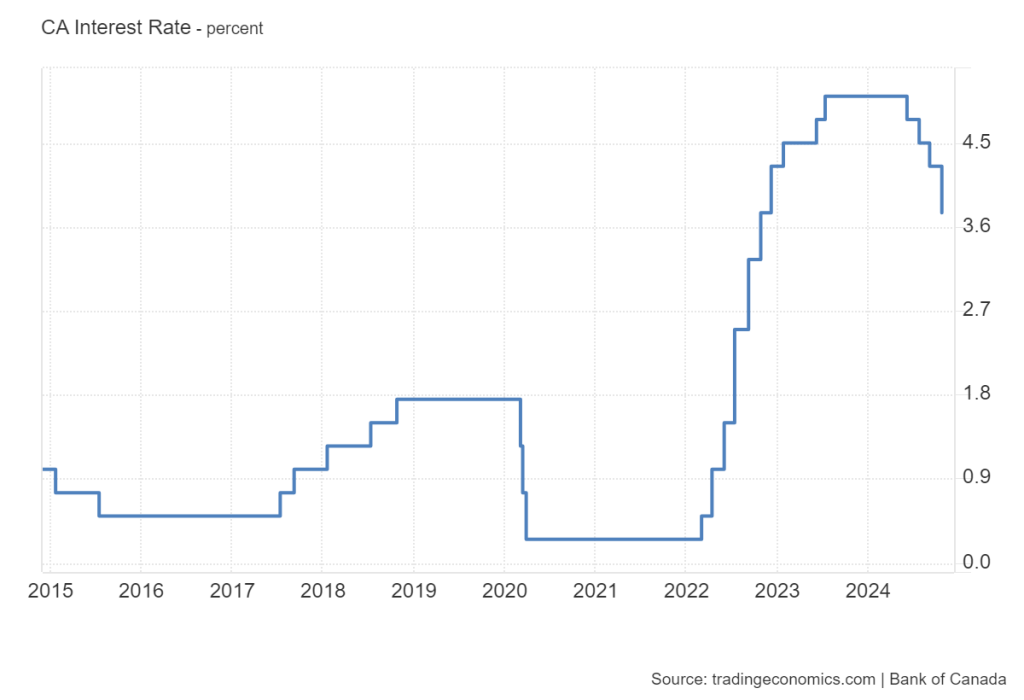
The overnight lending rate was dropped by half a percentage point, the largest drop since March 2020, when the rate was dropped 50 points, 3 consecutive times, from 1.75% all the way down to 0.25%. It’s now sitting at 3.75%, well above the historical average of 2.72%. Bear in mind, the rate consumers will receive from lenders is closer to 5.75% or so. So keep that in mind.
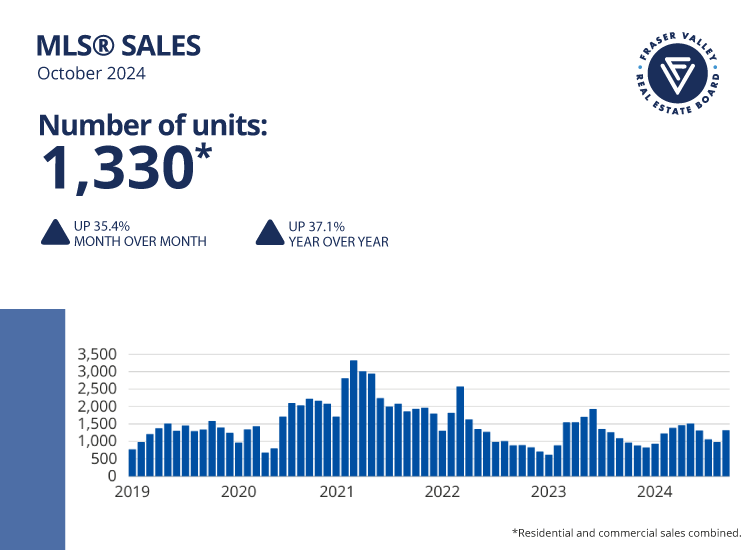
The Fraser Valley Real Estate Board recorded 1,330 sales in October, up 35% from September, and 37% year-over-year.
New listings declined in October, down 5% to 3,194, but increased 26% year-over-year. Overall inventory dipped in October to 8,799, down 3% from September, but up 34% over last year. Rising sales and steady inventory levels have the Fraser Valley in a balanced market with a sales-to-active ratio of 15%, according to the board. The market is considered to be balanced when the ratio is between 12% and 20%.
Most markets across the valley saw modest bumps in sales, with prices either flat or down slightly. As always, some markets are doing better than others.
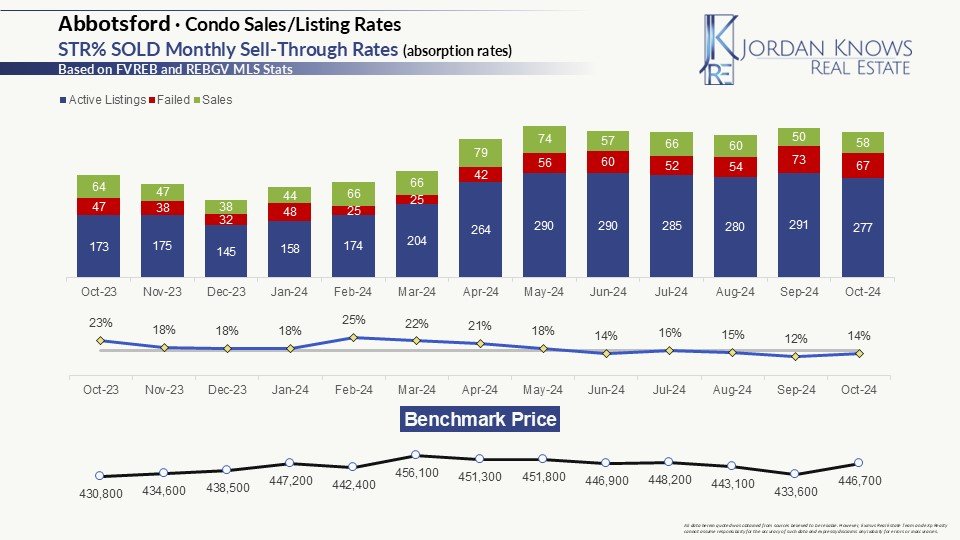
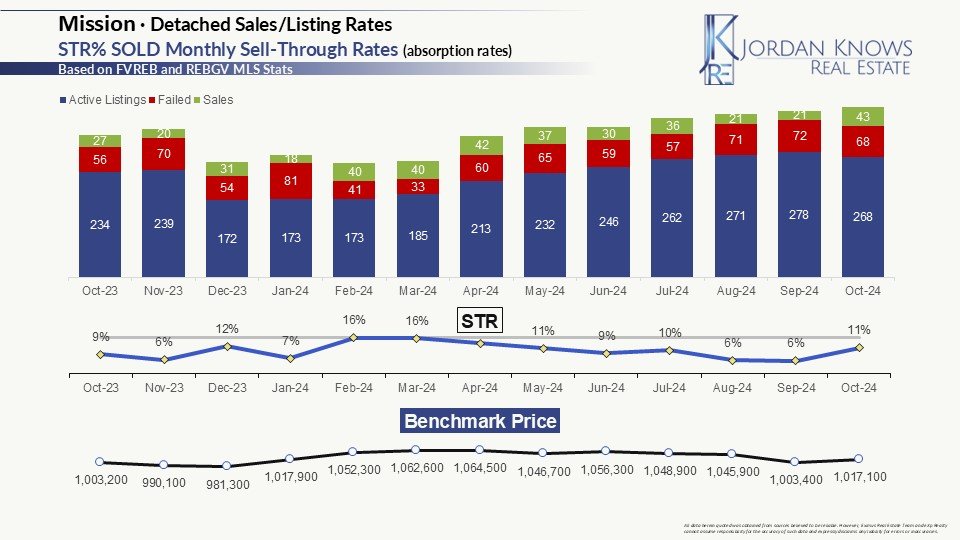
Abbotsford & Maple Ridge condos, for instance, both saw healthy increases in sell through rates and average sale prices. This continues the trend we’ve been seeing for a while now of condos performing well compared to townhomes and detached homes.
My argument is that they represent the most affordable entry point, and we’ve likely reached, or are very close to, the bottom of the market for this particular housing type.
Across the Fraser Valley in October, the average number of days to sell a single-family detached home was 34 (that’s 1 day faster than last month), Townhomes took, on average, 29 days to sell(Also 1 day faster than last month), while for a condo it was 32 (That’s 5 days faster than last month).
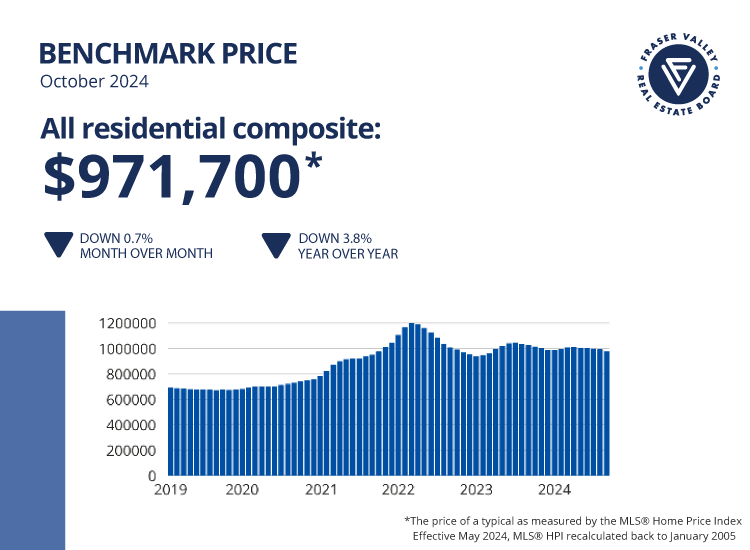
Benchmark prices in the Fraser Valley dipped for the seventh straight month in October, with the composite Benchmark price down 0.7% to $971,700.
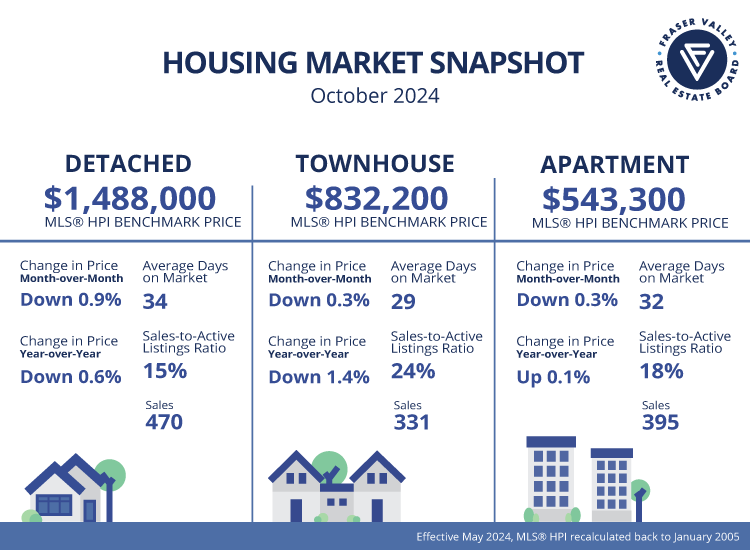
Taking a Look at Benchmark Price Activity
- Single Family Detached: fell to $1,488,000, down 0.9% from September 2024 and down 0.6% compared to October 2023.
- Townhomes: fell to $832,200, down 0.3% compared to September 2024 and down 1.4% compared to October 2023.
- Apartments: fell to $543,300, down 0.3% compared to September 2024, but that’s up 0.1% compared to October 2023
5 year bond yield It’s unlikely that we’ll see any break in fixed rates for the foreseeable future, with bond yields spiking again recently. It seems that any activity based on cuts were already predicted and priced in. We’re seeing fixed rates in the mid 4’s at the moment, but I don’t believe we’ll see any sort of significant increase until we hit the mid 3’s or better.
This is when a lot of the inventory on the market starts to make sense as investment product from a cash flow perspective, even at today’s prices, and that increased market pressure from investors returning to the pool will work to increase activity.
Anecdotally, things have picked up a bit, and many of the colleagues I’ve discussed this with are seeing the same thing, but only marginally. Keep in mind, a 35% increase over one of the slowest months in a decade, is still slow, just less so.
Personally I believe that this is a delayed response to the usual fall uptick we would have seen back in September. The larger industry narrative is that rate drops drove this movement, but at nearly 6%, variable rate mortgages aren’t the driving force here, and fixed rates haven’t changed.
What’s more likely is a slight release of some pent up demand, as buyers said “screw it” and pulled the trigger. Prices are falling so slowly month over month, that waiting another 3 or 4 likely isn’t going to net out a huge difference with strong negotiations, and once they find the right home, many are thinking it’s close enough.
I also believe there is a contingent of buyers that bought early knowing that rates will continue to drop, and prices will likely rise eventually, so why pass on the home that ticks all the boxes and risk not finding something similar. This is especially true in condos, where month over month activity has increased and prices are up slightly over last year.
All that being said, we’re heading into what is historically the slowest time of the year. Usually the balance of both listings on market and number of active buyers decline through the winter, keeping a semblance of equilibrium, but with so much active inventory, I expect we’ll see sales drop off relative to inventory and prices continue to trend down.
That means that if you’re a seller, you still want to be super sharp and front of the pack as far as value, because if you’re a buyer you’ll have lots of options, and if you’re not in any rush, waiting a couple more months may net you a slightly better deal; that window is closing quick though.
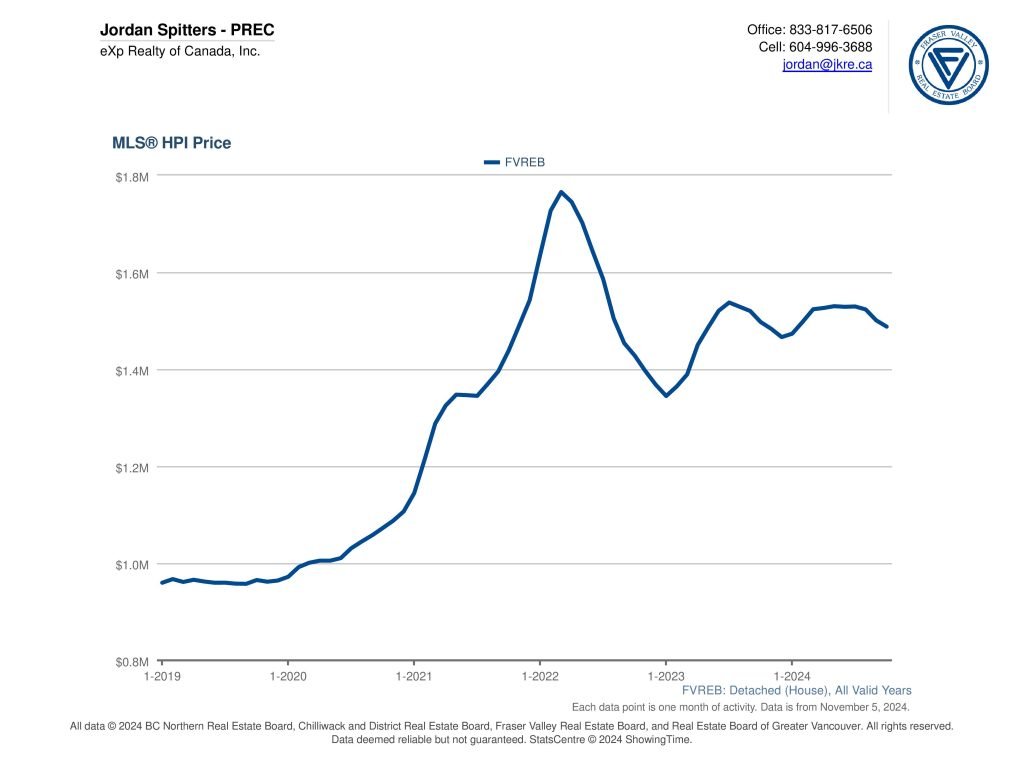
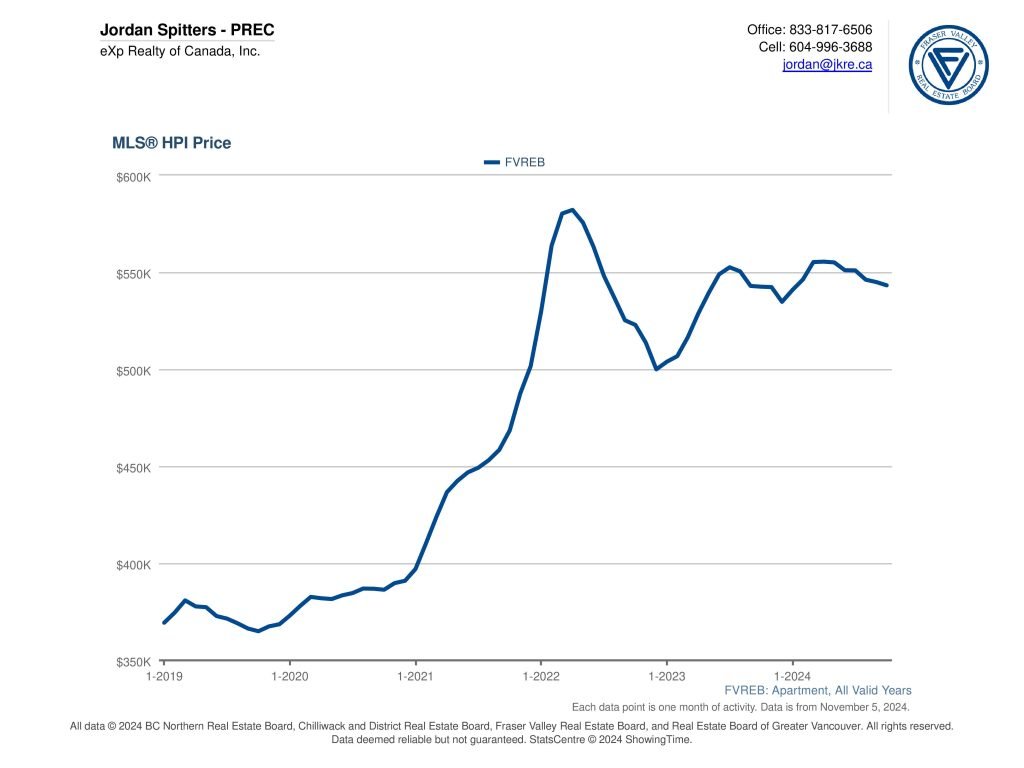
Looking at HPI for all housing types, we can see they’ve bottomed out in either December or January for the past 2 years, and I would expect to see the same thing this year.
In other news, housing starts in Vancouver are down 19% year over year, but it’s worth noting that 2023 was a record high year.
Conservative Sales Tax
The Federal Conservatives have also doubled down on their call to eliminate GST on the sale of new homes under $1 million, by asking Premiers to pledge to remove provincial sales taxes as well. This is good timing, as I just released an article where I calculated the total Property Transfer Tax (PTT) collected here in BC since its inception.
These taxes are burdensome, to say the least, don’t accomplish what they were originally introduced to do, and the amount of money collected is astronomical. We’re talking well over $35 billion after accounting for inflation, with over $18 billion in the last 8 years alone. Yet somehow deficits keep piling up. Make that make sense…
Frankly, I’m of the mind that sales taxes on housing should be significantly curtailed or removed entirely, especially on homes that have been traded many times over. You shouldn’t be punished for normal moves to provide your family with the home they need.
But that’s just my opinion, and I’d love to hear yours! Do you think the market will bottom out in December or January and start climbing from there, or continue trending down into the new year? Should sales taxes on new homes be scrapped, or are they necessary to fund social services? What about resale?
And as always, if you have any questions all things Fraser Valley Real Estate, whether that’s buying, selling, or investing, give me a call!


